A hundred years ago, the first World War was gradually developing. The political and military turmoil affected the stock exchanges all over the world and the Dutch stock exchange closed. In the Netherlands a run occured for physical silver and the government decided to issue the so-called 'Zilverbon', which was a future claim to physical silver as it would become available. Almost overnight, the payments infrastructure was changed; an infrastructure that was mostly based on the use of cash rather than bank accounts and payment instruments.
Fast forward to today: after a long period of careful planning, we are again at the verge of changing our payment infrastructure by moving to European standards in the retail payments domain. Both political and economic drivers have caused a massive technical change, which to the consumer is mostly visible via the ultralong new bank account number IBAN that has to be used as of tomorrow.
What changed in the mean time?
In between these two historic moments we witnessed:
- the gradual development of city giros, nationwide giro and bankgiro systems, account systems and the development and issuance of domestic payment instruments (acceptgiro, standing order, direct debit, guarantueed cheque, card and app payments),
- a continued learning process with respect to counterparty risk (on the exchange or with respect to banks and countries) and the development of a lot of regulation to mitigate this,
- two world wars, followed by the further economic integration of European countries into the European Union; a body that shows Member States that are still struggling with their position with respect to military action in the Eastern parts of Europe, bordering Russia,
- an improvement in living conditions, welfare and wealth.
What really changed?
It is not easy to distinguish the underlying changes in our society. Technological change may often appear to be progress while it simply reflects and allows the human faults to be reproduced on a more advanced level.
Still, I would hope the most significant change over the last century to be that we have created a number of institutions (UN, GATT, BIS, World Bank, IMF) that allow countries to not fight their battles on the ground but in economic terms. There are of course deficiencies within these institutions, but I would hope that we will move forward in using these structures to limit the amount of military conflicts as much as possible.
Showing posts with label Municipal Giro. Show all posts
Showing posts with label Municipal Giro. Show all posts
3.1.12
Dutch Point of Sale system PIN ceases to exist...
This new year brings with it another historic moment. The PIN-system for Dutch cardpayments disappears. Here in the Netherlands, we had one of the cheapest and efficient implementations of point of sale payments: PIN. But the evolving technology (chip), fraud figures for magstripe as well as the increasing internationalization (European integration) made us migrate to Maestro instead. Of course this is Maestro with a Dutch flavour because the Dutch merchants have negotiated a good prices deal with the collective of individual banks.
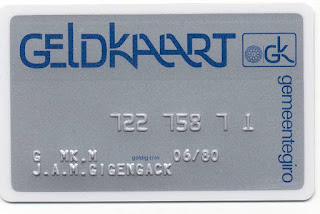
Just for fun I figured I would provide a picture of one of the earliest operational debitcards in the Netherlands: a 'Geldkaart' issued by the Gemeentegiro (kindly provided by John Gigengack). So you can see where it all started here:
For the consumer the migration means that he or she has to dip the card rather than swipe it. And on the online-banking systems and account statements they may notice that the payments in some cases are no longer directly debited but first 'reserved' to be finally debited and booked some days later. Other than that, I expect that to the consumers the concept of PIN is not so much related to the brandname PIN but to the use of a card with PIN-code. So to them PIN may disappear but they keep on 'pinning'.
Just for fun I figured I would provide a picture of one of the earliest operational debitcards in the Netherlands: a 'Geldkaart' issued by the Gemeentegiro (kindly provided by John Gigengack). So you can see where it all started here:

For the consumer the migration means that he or she has to dip the card rather than swipe it. And on the online-banking systems and account statements they may notice that the payments in some cases are no longer directly debited but first 'reserved' to be finally debited and booked some days later. Other than that, I expect that to the consumers the concept of PIN is not so much related to the brandname PIN but to the use of a card with PIN-code. So to them PIN may disappear but they keep on 'pinning'.


4.7.11
Retronaut... .interesting site.... with history of Amsterdam in retro-foto's
Today I ran across a site on the web called the Retronaut. It is a site that aims to make pictures of the situation in a city right now and compare it to earlier days. And it has a special section on (the ghosts of) Amsterdam. And the interesting thing is, this method of making pictures on exactly the same spot as many years earlier is something I quite like doing. I don't have that much readily available on financial history however.
Except for one sketch of the desgn of the main office of the Nederlandsch-Indische Handelsbank, built between 1910-1912 and designed by architects: van Rossum and Vuyk. In 1925 the building was expanded by the architect van Gendt.

The building in 1962 turned into the head-office of the Municipal Giro of Amsterdam....

which in turn became the Main Post Office in Amsterdam...

which closed in January 2011 this year and now has space to rent....
Except for one sketch of the desgn of the main office of the Nederlandsch-Indische Handelsbank, built between 1910-1912 and designed by architects: van Rossum and Vuyk. In 1925 the building was expanded by the architect van Gendt.

The building in 1962 turned into the head-office of the Municipal Giro of Amsterdam....

which in turn became the Main Post Office in Amsterdam...

which closed in January 2011 this year and now has space to rent....
Subscribe to:
Posts (Atom)