Today marks the end of a period of almost hundred years of consumer payments in the Netherlands. Here is a brief reflection on this period. My hope is that we retain our innovative mindset and that we abandon old school practices like: competition on technology and inward-thinking-based marketing practices.
The beginnings
It all started out with a certain demand of the public and small retailers, around 1900. It took however more than ten years before the city giro of Amsterdam (1916) and the national giro of the Netherlands (1918) were set up. In the period leading up to this moment, the cashiers were asked whether they wished to improve their services, as this might lead to the parliament to conclude that no national giro was necessary. Their response was too meagre as a result of which they created their biggest rival: the national giro system, operated by government.
This system effectively created a benchmark for the private industry by offering (some time after it's start) payment services for free to the public. Today we would call this the Internet model, but in those days, this lead to repeated discussions on the undue competition element. Bankers and cashiers assumed that the national giro was cross-subsidized by government; while effectively the reverse became true. The national giro acted as a cash cow that covered some of the other costs for the Ministry of Transport (including the costs of post offices etc).
The city giro Amsterdam has stood out mostly for its innovations: the use of modern bookkeeping machines, the introduction of photo-imaging (in the 1930s) to process payments easier as well as the early introduction of a payment card to the public. The national giro, in turn, was early to create a mechanism of inpayments that could be used by government services, that used similar (punch card) standards.
In this respect it should be noted that the national giro, during the previous century, was plagued by several operational distortions, leading to 'giro stops'. One big one occurred in the 1920s and shut the system down for almost a year, other ones happened after the second world war. These stops instilled a big trauma into the organisation with the effect that when in 1965 a change was made to using punch cards and mainframes, this was done with meticulous scientific precision in order not to fail. Ever since, the postal giro (later Postbank) would be very keen and strong in the area of operational logistics and control.
Competition on standards and technology
For the most part of the evolution of Dutch payments, there were differences in technology used. A first attempt to bridge these differences occurred after the second world war when a commission on the integration of giro traffic tried to bridge the bankers vs giro gap. This didn't work out.
In the mid 1960s the bankers were keen to find funding in the retail market and realised they needed a better clearing system to process faster payments. While they were in the process of deliberating this move, the postal giro offered them to join/use the same standards as they were, in order to achieve uniform processing. For strategic reasons, the banks decided not to do this and chose a slightly modified technology and numbering system of their own. Remember: this was of course the age of shielding off markets by technology.
The net effect for the consumers and companies was less positive however. In the end it took some 30 years to create bridging standards/protocols to integrate the different payment standards of bank and giro. And even when the digital, networking time started (in the 1980s) banks and giro found it hard to abandon the classic competition by technology paradigm. For the EFTPOS network they did use a common standard and this also seemed to work for the Chipknip e-money products. Yet, due to misunderstandings and distrust at the board room level, the Postbank decided to jump the Chipknip ship to start the separate Chipper product. Again, the effect was that consumers and retailers were burdened with dual standards in a market that is too small to do so.
Inward based marketing of the big banks
With the deregulation of financial markets and the privatisation of the Postbank, all providers of payments were commercial companies. The Dutch banks grew bigger and with that their bureaucracies. Postbank gradually lost its touch-and-feel as a former public entity and became a bank like all others. The best event that symbolises this is the abolition of the Postbank brand by ING.
The net effect of becoming bigger and more ambitious is that straightforward customer research and marketing gets stampified. This is a word that I coined to denote the fact that in those big banking bureaucracies the responsibilities of employees - with the only exception of the board - becomes limited to the size of a postal stamp. The result is that these companies (marketing) departments require more time for internal debate, offcie politics and consensus-finding which they can't spend at finding out how to best serve the customer.
The consequence of this stampification is that the banks lose touch with their customers and reality. Our last retail payment product, the Chipknip, showed this most clearly. The ridiculous local battle between two competing e-money schemes (although perfect from a competition perspective) created so much nuisance for retailers that this inspired them to get back at the banks. Infuriated by high terminal switching costs, they found the newly set up competition authority at their side to fight the banks cartel behaviour.
As such our retailers were quite successful: the banks were being fined and a part of the fine was channeled towards them (via a Covenant) to improve the EFTPOS situation in the Netherlands. This Covenant was even prolonged to ensure a continued collective rebate for retailers on EFTPOS fees. Effectively we could thus see the retailers as being the clear winners in the last 15 years of retail payments here in the Netherlands. [And as with today's MIF-debate we can wonder whether the benefits they derived from emptying the pockets of banks did really end up in the consumer pockets by lower prices.]
Back to inward-based-marketing: the best (and typical) example is the way the Chipknip product was initially taken off the market. Banks informed the customers that they all had to unload their Chipknips at specific loading/unloading points. This lead to a big confusion and questions on twitter. Eventually some individual banks decided to give the money back on the basis of the internal administration so that customers didn't need to bother going to an obscure loading point. And then, quickly, all banks decided to do this.
I sincerely hope that we will no longer witness these old school thinking marketing methods in the new year. Banks need to find a way to innovate and listen to clients and society or they will be trapped in old behaviour that is only comprehensible from a stampification point of view but not understandable for customers outside the bank.
Outlook
If history is anything to go by, we may well see a repetition of the SEPA-dynamics in the banking domain. What I mean with that is the following: as banks are busy lining up their internal systems in order to conform with a whole range of upcoming new EU regulation (keywords: PSD2, MIF, AML), the non-banks will be able to build all kinds of new products at the fringes of the payments market.
Most of these new products won't be made from a payments perspective but will solve a user problem. Creating a payment button in these products doesn't require much more than a direct customer relation and a European direct debit agreement. So we might well see the banks moving into a back-seat role of providers of the payment rails for non-bank providers of user services.
Showing posts with label financial history. Show all posts
Showing posts with label financial history. Show all posts
28.5.14
The Dutch experience with standing committees in the retail payments domain
On Friday, the 16th of May, the Euro Retail Payments Board (ERPB) held its first meeting in Frankfurt. The start of this new institutional body may raise questions in the industry as to its exact objectives and what it will achieve in practice. However, Dutch history shows that there are clear benefits to having long-term standing committees in the retail payments sector.
Standing committees in payments: the Dutch case
Originally, the Dutch market for retail payments consisted of privately owned commercial banks, savings banks and cooperative banks that competed with the government-operated Postal Cheque and Giro Services. The system design of these providers differed. The private players had set up the so-called Bankgiro system as opposed to the Postal Giro system of the State.
In the 1980s, the technology difference served as a barrier between the institutions, which remained in place until the State privatized its Giro-services in 1986. Subsequently the work started on the harmonization of technical standards by means of the work on the Dutch Payments Circuit (Nationaal Betalings Circuit). It took until 1998 for all the different types of payment mechanisms to be fully harmonized.
Although it did take quite some time to harmonize the technical standards in the Netherlands, the regular interaction between industry players improved the trust and willingness to cooperate on issues of common concerns. So when the need arose, in the 1990s, to drive down the costs of retail payments a dedicated task force was set up. The task force developed an array of measures and communication to steer the users to the most efficient payment mechanisms. The effects in changing the payment mix in the Netherlands were clearly visible.
National Forum on the Payment System
At the end of its term, in 1995, the task force was converted into a standing committee on the efficiency of payments in which both the demand and supply side were represented.[1] This standing committee was the precursor to the National Forum on the Payment System that was set up in 2002. This National Forum functions as the platform in which issues with respect to retail payments are discussed between representatives of suppliers and users of retail payments.
[1] The so-called Working Group on Efficiency in Payments: ‘Werkgroep Efficiency Betalingsverkeer, which was chaired by Mr. Klomp, a highly respected representative of Dutch retailers.
Over time, the Forum has established working groups on the migration to EMV, on the migration to SEPA, on usability, security and efficiency. It has become the platform for discussion of market developments and collective decision making to improve payments in the Netherlands. For example, when the 1 and 2 eurocent coins in practice created too much confusion for consumers and unnecessary costs for merchants, the members in the forum agreed to abolish the use of these cents and to implement a rounding procedure. This improved the efficiency of Dutch retail payments by approximately € 30 million per year.
Unlocked potential in forming bonds and creating trust
In the Dutch situation there have been many participants to these standing committees and working groups that at the time felt that a lot of their work amounted to pushing back and forth paperwork rather than contribute to real life problems. And to be honest: at some stages of the process or in some working groups this may have been the case.
I have spoken to quite a number of participants to such committees and working groups. In hindsight most of them acknowledge the value of the trust and bonds that are being built by working together with opponents and competitors on issues of interest. These bonds and relations spilled over into an increased trust and cooperation outside the formal scope of the committees an working groups. Both board members and technical experts create a wider and trusted network of counterparts that were consulted when the need arose.
We should therefore recognize that apart from the actual output, the ERPB work in itself will also create trust an bonds in the European retail payments industry. This will unlock further potential and further cooperation that will be beneficial to all in the retail payments sector. It is this 'hidden value' that must not be underestimated.
[1] The so-called Working Group on Efficiency in Payments: ‘Werkgroep Efficiency Betalingsverkeer, which was chaired by Mr. Klomp, a highly respected representative of Dutch retailers.


27.2.14
Frijda's theory of money (1914): still relevant for bitcoiners today
 This week, Mount Gox, a very large provider of bitcoin services, couldn't live up any more to its services agreements with bitcoin users. It provided exchange and storage services for bitcoins, but due to a technical implementation flaw, the bitcoin holdings of users were compromised. Essentially it wasn't clear who really owned the bitcoins. The website went black and users can no longer claim their bitcoins.
Tumbling off the learning curve
I view the failure of Mt Gox as a logical consequence of the learning curve that bitcoin holders and bitcoin companies face. The bitcoin, although considered decentralized, is just as centralised a system as any other value transfer mechanism. However, for ideological reasons, the developers chose to only describe the technical heart of the system (the algorithm) leaving the rest up to the market.
This open source code approach has some advantages, among which a very speedy development of applications. Yet, we are for some time now witnessing what it means if systems lacks a central authority or scheme manager. There is no entity taking responsibility for the proper application of this scheme so no one is chasing users or companies because they don't abide by:
- usage conditions (demanding user identification),
- security requirements and certification of tools,
- specific legal frameworks.
As a result we have seen a whole community of interested companies and users climbing up the payments, banking, investments and monetary learning curve. The inevitable consequence is that those who do not get it right, will pay a price, while the others continue to learn. Due to the digital nature of bitcoin, these developments unfold rapidly, allowing us a compressed overview of interactions and developments from financial history.
Frijda's theory of money (1914)
The essential lesson at stake is that the usage of any value transfer mechanism does not just rest on its acceptance by users, but just as well on the rules and regulations that underly the value transfer. In 1914, the Dutch lawyer Frijda analysed this topic in his dissertation on the theory of money. At that time discussions emerged on the nature of banknotes. Did they have value because they were exchangeable for bullion, because they were defined as legal tender or because the public used and accepted it?
Frijda pointed out that the underlying legal framework that safeguards property in a society constitute a necessary precondition for the use of payment instruments. Without such safeguards, people will tend to stick to other stores of value rather than attaching value to local bank notes. Until today this effect is clearly visible: consumers tend to hold and use foreign cash or commodities if they live in country with a lot of curruption, a weak system of justice and an instable monetary climate.
Trust is built by institutions and markets
What makes money tick is a solid institutional basis, upon which trust can be further developed. The latter part can be done by a combination of regulation (supervision) and self-regulation (market action). Which brings us back to the Mt Gox cas.
Following the events of this money, a statement was released by the bitcoin companies Coinbase, Kraken, BitStamp, Circle, and BTC China. The industry leaders committ to safeguarding the assets of customers, to applying strong security measures, to using independent auditors to ensure integrity of their systems and to have adequate balance sheets and reserves to be able to ensure continuity.
In sum we can now see both a gradual development of both the institutional framework for virtual currencies and the market-driven self-regulation. This reflect the fact that - whether you like it or not - trust for financial services is always built on institutions, regulations and self-regulation.
30.12.13
All 2013 activities for Financial History of Amsterdam
Launch of digital museum 'Financieel Erfgoed op de Kaart'
 2013 started out with the launch of our digital museum on Financial History. It is called Financieel Erfgoed op de Kaart and is a website that contains the stories and lokation where financial history happened. The site can be viewed on the desktop, in which case it looks like a rich google-map, or via the mobile. The mobile is sensitive to the location and will show the nearest hot spots of history as well as a responsive mobile menu. The launch was covered in both national and regional media and has a steady flow of visitors ever since.
 2013 started out with the launch of our digital museum on Financial History. It is called Financieel Erfgoed op de Kaart and is a website that contains the stories and lokation where financial history happened. The site can be viewed on the desktop, in which case it looks like a rich google-map, or via the mobile. The mobile is sensitive to the location and will show the nearest hot spots of history as well as a responsive mobile menu. The launch was covered in both national and regional media and has a steady flow of visitors ever since.
Boat- and walking tours
We organised several taylor-made walking tours on the financial history of Amsterdam for visiting US Students, Norwegian insurers, financial supervisors, Nyenrode college students, employees of Booking.com and the Dutch Ministry of Economic Affairs. On top of that we introduced a boattour on the financial history of Amsterdam, for two large organisation in the financial sector.
We organised several taylor-made walking tours on the financial history of Amsterdam for visiting US Students, Norwegian insurers, financial supervisors, Nyenrode college students, employees of Booking.com and the Dutch Ministry of Economic Affairs. On top of that we introduced a boattour on the financial history of Amsterdam, for two large organisation in the financial sector.
April: Filosofy night on guilt and debt
In april of 2013, the Filosofy night was dedictaed to the theme of guilt and debt. We presented an overview of history and future of money with the title: “Back to the future”. In addition we joined a radio show conversation with Werner Trio of Radio Klara on the topic of money and value.
In april of 2013, the Filosofy night was dedictaed to the theme of guilt and debt. We presented an overview of history and future of money with the title: “Back to the future”. In addition we joined a radio show conversation with Werner Trio of Radio Klara on the topic of money and value.
The Filosofy Night occured in the former Exchange building: 'de Beurs van Berlage'. This inspired us to dedicate a separate part of our virtual museum on the financial history to this site. Since then, all visitors of the Exchange building can use their mobile phone to have a look at the financial history of that building.
Lectures/workshops/blogs
We wrote some guest blogs. One was about Leviathan for Felix Meritis, the other was a blog on the hands, swearing an oath, at the Amsterdam Museum site. Apart from that we regularly published in the online-blog of the Dutch Financial Newspaper: het Financieele Dagblad. We presented an unknown story of Amsterdam's city giro for a festive event in June and held a workshop on the future (and past) of money for a large financial institution.
We wrote some guest blogs. One was about Leviathan for Felix Meritis, the other was a blog on the hands, swearing an oath, at the Amsterdam Museum site. Apart from that we regularly published in the online-blog of the Dutch Financial Newspaper: het Financieele Dagblad. We presented an unknown story of Amsterdam's city giro for a festive event in June and held a workshop on the future (and past) of money for a large financial institution.
Radioshow: Casa Luna
To end the year, we were asked to join the Dutch radio show Casa Luna to talk about the history of money, alternative payments and the current situation in the banking sector. This was a very inspiring two hours of discussion, with a nice deviation to the role of artists and their capability to point out the faults in the financial system, way before supervisors acted.
2014: pubquiz and walking tour apps
In 2014 we will continue sharing our passion for financial history with all visitors to Amsterdam. We will develop a pub quiz on financial history and launch an iTours app on the financial history of Amsterdam. It will show pictures from the city archive and allow you to experience the history in your own pace.
We look forward to seeing you in the new year !
To end the year, we were asked to join the Dutch radio show Casa Luna to talk about the history of money, alternative payments and the current situation in the banking sector. This was a very inspiring two hours of discussion, with a nice deviation to the role of artists and their capability to point out the faults in the financial system, way before supervisors acted.
2014: pubquiz and walking tour apps
In 2014 we will continue sharing our passion for financial history with all visitors to Amsterdam. We will develop a pub quiz on financial history and launch an iTours app on the financial history of Amsterdam. It will show pictures from the city archive and allow you to experience the history in your own pace.
We look forward to seeing you in the new year !
19.9.13
Tapering delayed: another historic moment for the FED?
Yesterday evening, Money 2.0 was on the agenda in the Arminius church in Rotterdam. It was an evening in which I briefly outlined some of the major developments and lessons from monetary history to the audience. This coincided with an announcement of the Federal Reserve Board on their monetary policy, that may prove to become a historic case in point.
Balancing the amount of money against economic activity
I explained that history learns us that the amount of money in a society needs to balance the economic activity. The role of central banks is to monitor both and make serious judgment calls as to whether or not contract or expand the so-called monetary base. Expanding too much may lead to high inflation, and a more restrictive approach can lead to deflation. Finding the right balance is thus the essence of monetary policy.
I sketched that each country has in the past experienced a different learning curve in executing monetary policy. These differences help to explain why the German central bank (and the ECB, in its first years of existence) tend to be restrictive and careful not too expand the money base, while the FED appears to lean towards easing the money supply. As if to prove my point, at that very moment, the FED informed the markets that they were delaying their planned contraction of the monetary base until the economy would be seriously better.
Now, let's see where this might be coming from.
Different lessons lead to different central bank styles
First, we will look at the situation in Germany between the two World Wars. Germany had to pay France a huge amount of money as 'repair' payments for the damage done in the war. A sequence of events in 1922 however makes it clear that the Germans will have a hard time paying back their money. And as a part of the conflict between France and Germany, the Germans start printing money, to finance a strike in the industrial area of the Ruhr. The cumulative effect of the developments - see Kindleberger- was hyperinflation and even the Dutch still recall this (some of us are still holding worthless million mark notes of those days).
Now, let's have a look at the United States at the end of the 19th century. We can see a depression, deflation and a shortage of money. And there is a serious debate as to the use of gold or silver as a standard to base the currency on. This discussion even filters down to a book, the Wizard of Oz, as Hugh Rockoff explains here. In short, the US experience is that you have to be careful not to have a shortage of money.
As both memories linger on in the collective minds, we can thus see that the German central banking approach is not to ever encounter high inflation again. They tend to be on the careful side and tried their utmost to instill this sense of discpline in the European Central Bank. Meanwhile, the FED is making sure not to ever encounter a shortage of money again, so are expanding their money base more easily.
Delayed tapering: a historic moment ?
When the FED yesterday announced that they were not yet going to contract the money base, this came as a surprise to the market. Earlier this year, Bernanke had explained that the FED would slowly start contracting the money supply. So he caught the market off guard. And in a few years, we can determine if that was indeed a historic moment. I think it was.
The FED-announcement above all marked the beginning of an unclear policy. So far the FED has been careful to explain and predict its own moves to the market by providing so-called forward guidance. While a bit unconventional, the market has been getting used to this guidance and has also responded to the earlier announcement of more restrictive monetary policy. This response may in turn have led the FED to change its previous opinion on the timing of tapering.
What may happen now is that the market and the FED get entangled in a dance where neither party knows whether to lead or to follow. Both are looking at each other while trying to find out if the economy itself is getting in a better or worse shape, as a result of their dancing. Rather than leading the dance, based on the music, the FED is now adapting to the dance partner as well.
It's this ambiguity of the FED and increased unpredicatbility that may well make yesterdays announcement a historic one.
Balancing the amount of money against economic activity
I explained that history learns us that the amount of money in a society needs to balance the economic activity. The role of central banks is to monitor both and make serious judgment calls as to whether or not contract or expand the so-called monetary base. Expanding too much may lead to high inflation, and a more restrictive approach can lead to deflation. Finding the right balance is thus the essence of monetary policy.
I sketched that each country has in the past experienced a different learning curve in executing monetary policy. These differences help to explain why the German central bank (and the ECB, in its first years of existence) tend to be restrictive and careful not too expand the money base, while the FED appears to lean towards easing the money supply. As if to prove my point, at that very moment, the FED informed the markets that they were delaying their planned contraction of the monetary base until the economy would be seriously better.
Now, let's see where this might be coming from.
Different lessons lead to different central bank styles
First, we will look at the situation in Germany between the two World Wars. Germany had to pay France a huge amount of money as 'repair' payments for the damage done in the war. A sequence of events in 1922 however makes it clear that the Germans will have a hard time paying back their money. And as a part of the conflict between France and Germany, the Germans start printing money, to finance a strike in the industrial area of the Ruhr. The cumulative effect of the developments - see Kindleberger- was hyperinflation and even the Dutch still recall this (some of us are still holding worthless million mark notes of those days).
Now, let's have a look at the United States at the end of the 19th century. We can see a depression, deflation and a shortage of money. And there is a serious debate as to the use of gold or silver as a standard to base the currency on. This discussion even filters down to a book, the Wizard of Oz, as Hugh Rockoff explains here. In short, the US experience is that you have to be careful not to have a shortage of money.
As both memories linger on in the collective minds, we can thus see that the German central banking approach is not to ever encounter high inflation again. They tend to be on the careful side and tried their utmost to instill this sense of discpline in the European Central Bank. Meanwhile, the FED is making sure not to ever encounter a shortage of money again, so are expanding their money base more easily.
Delayed tapering: a historic moment ?
When the FED yesterday announced that they were not yet going to contract the money base, this came as a surprise to the market. Earlier this year, Bernanke had explained that the FED would slowly start contracting the money supply. So he caught the market off guard. And in a few years, we can determine if that was indeed a historic moment. I think it was.
The FED-announcement above all marked the beginning of an unclear policy. So far the FED has been careful to explain and predict its own moves to the market by providing so-called forward guidance. While a bit unconventional, the market has been getting used to this guidance and has also responded to the earlier announcement of more restrictive monetary policy. This response may in turn have led the FED to change its previous opinion on the timing of tapering.
What may happen now is that the market and the FED get entangled in a dance where neither party knows whether to lead or to follow. Both are looking at each other while trying to find out if the economy itself is getting in a better or worse shape, as a result of their dancing. Rather than leading the dance, based on the music, the FED is now adapting to the dance partner as well.
It's this ambiguity of the FED and increased unpredicatbility that may well make yesterdays announcement a historic one.
16.8.12
The art of reserve banking (at the Zuid-as Amsterdam) !
Reserve Banking is an art. While Draghi and Bernanke are highly qualified and professional economists, they also master the art of performance. As true actors, they use their voice, their remarks, eyebrows and somewhat vague statements to provide hints and indications that the market then swiftly responds to. It is something you can't learn from the books. It's an art that can only be mastered in practice.
Since this year, the Zuid-As in Amsterdam is also home to the art of reserve banking. But it's a bit different. I heard about it yesterday, when visiting the Holland Financial Centre. From high up in the nearby Symphony building I looked down onto a small rectangular area of the Art Reserve Bank, well fenced, with cameras and three small office buildings. One is the minting press, the other is the teller and the third one was hard to identify. It looked like this:


Money, dreams and art
Since this year, the Zuid-As in Amsterdam is also home to the art of reserve banking. But it's a bit different. I heard about it yesterday, when visiting the Holland Financial Centre. From high up in the nearby Symphony building I looked down onto a small rectangular area of the Art Reserve Bank, well fenced, with cameras and three small office buildings. One is the minting press, the other is the teller and the third one was hard to identify. It looked like this:
The Art Reserve Bank: an experiment
What happens there is a unique experiment. A group of artists have set up, without any monetary funding, a so-called Art Reserve Bank. The plan was there for some time, but as the financial crisis came along, it became easier to convince sponsors to join a project that questions the value basis of money. The main idea is that there is far too much money circulating in the world and that the crisis demonstrates that we need a new approach towards money and debt. And in the experiment, art (or: the intrinsic value of human artistic expression) becomes the money. And thus helps to freshen up or minds and stimulate us to re-think our concept of money.

The idea is that for a period of five years, each month 400 coins are minted. These are 4 series of 100 coins per week, costing 100 euro each. For each month: a different artist is asked to design the coins, which all bear the same backside with the motto: ARS PECUNIA MAGISTRA: Art is the teacher of money. A nice motto and also a tongue-in-cheek reference to the Amsterdam Zoo that bears the motto: Natura Artis Magistra (Nature is the teacher of Art).
Anyone can buy coins and thus becomes a member of the Cooperative Art Reserve Bank (Kunstreservebank). All holders of the coin are thus the collective owner of the bank. Of the 100 euro costs, 90 % is used to pay for the operational cost of the experiment and 10 % is withheld as a 'cash reserve'. Should a buyer not appreciate his/her work of art, he can return it to the bank and get the original value back with a 10% interest fee. There is also a dealing room on the site of the bank, for those who wish to buy or sell their coinst. And at the end of the five years, all owners of coins can collectively decide what will happen with accumulated capital (if there is any and if the bank stil exists).
Money, dreams and art
The experiment challenges one to consider: what is happening in our world of money and value?
For me, the Art Reserve Bank made me realize that there may now be so much difference between their coins and the official legal tender in circulation. Both coins are the product of our imagination, dreams and creativity. Which is quite clear for the Art Reserve Bank currency, but may be less clear for the euro. So let me try to explain.
What happened over decades is that we moved from a mentality of: save first, spend later, to a mechanism of: spend first, repay later. If your story about the future would be probable enough (having a job, education etc) some bank would lend you money. And the same thing was true for businesses. Essentially this is a mechanism where tough choices are made. If you don't have the job or a solid story explaining how you can repay in the future, you don't get money. Which all sounds very realistic.
Fact is however, that with hindsight we can now see that banks, consumers and companies have on a large scale lived in dream worlds with expectations of future income, growth that were not realistic after all. Money was created, lent on the basis of these dreams and imagination. And part of that money is now in our pocket. And we also know that some of the debts are definetely not going to be repaid in the future.
So wouldn't it be fair to state that some of our euros are just as much the result of our imagination, as the Art Reserve Bank coins?
2.4.12
Rabobank takes over Friesland bank... inevitable consequence of scale and business model
Today, all the financial news in the Netherlands is dominated by the takeover, by Rabobank, of Friesland Bank. Both are banks that originated in the agraric sector, as cooperative organisations that support local farmers and communities. As such Friesland Bank was the only remaining independent cooperative bank still standing. But now, the Competition Authority has immediately granted an 'express decision' to allow the merger between Rabobank and Friesland Bank. This means that the financial situation was serious and we may assume that the Dutch central bank (as a supervisor) chose to stimulate this merger between Rabobank and Friesland Bank (as is - in historical terms - their preferred way of keeping the bank sector healthy).
Now if we look at the earlier annual reports of the Friesland Bank we can see what was going on. Over the last five years, the majority of increase in income was due to the private equity function of the bank. So Friesland Bank was a bank and a private equity house at the same time. With the private equity part blossoming in the recent years, while at the same time being a risk factor. Meanwhile, Friesland Bank in some areas (for example processing of securities transactions) needed to cooperate with other banks to ensure a good provision of services. And then, when the market outlooks became more grim, the bank as a whole seriously suffered from the fact that 1) new banking rules led to a higher capital requirement for private-equite activities 2) the revenues of investment went down alongside the general gloomy outlook in markets and investments.
What is interesting is the tempo in which this take-over occurred. Because in essence, the risk profile of Friesland Bank (low revenue generating bank with risky private equity holdings) is of course no surprise to Supervisory Board nor to its supervisor: De Nederlandsche Bank. So one might wonder: what took them so long? What happened?
I think it's the combination of cultural and personal factors that may have slowed down this take-over. For that to understand, we must recognize that the Frysian Province of the Netherlands is a region with a healthy proud, and sometimes stubborn, attitude as to their uniqueness. They succeeded in getting their language to be maintained as an official administrative language in Friesland. They have the unique 11-cities skating race and many more customs. And it may have been this regional pride that may have stood in the way of their Supervisory or Executive Board of accepting the inevitable.
So while there is a lot more to say about this episode, it is fair to state that the Dutch central bank may now -after a number of well-criticized failures- pride itself in having safely managed and seen this transition though.
Now if we look at the earlier annual reports of the Friesland Bank we can see what was going on. Over the last five years, the majority of increase in income was due to the private equity function of the bank. So Friesland Bank was a bank and a private equity house at the same time. With the private equity part blossoming in the recent years, while at the same time being a risk factor. Meanwhile, Friesland Bank in some areas (for example processing of securities transactions) needed to cooperate with other banks to ensure a good provision of services. And then, when the market outlooks became more grim, the bank as a whole seriously suffered from the fact that 1) new banking rules led to a higher capital requirement for private-equite activities 2) the revenues of investment went down alongside the general gloomy outlook in markets and investments.
What is interesting is the tempo in which this take-over occurred. Because in essence, the risk profile of Friesland Bank (low revenue generating bank with risky private equity holdings) is of course no surprise to Supervisory Board nor to its supervisor: De Nederlandsche Bank. So one might wonder: what took them so long? What happened?
I think it's the combination of cultural and personal factors that may have slowed down this take-over. For that to understand, we must recognize that the Frysian Province of the Netherlands is a region with a healthy proud, and sometimes stubborn, attitude as to their uniqueness. They succeeded in getting their language to be maintained as an official administrative language in Friesland. They have the unique 11-cities skating race and many more customs. And it may have been this regional pride that may have stood in the way of their Supervisory or Executive Board of accepting the inevitable.
So while there is a lot more to say about this episode, it is fair to state that the Dutch central bank may now -after a number of well-criticized failures- pride itself in having safely managed and seen this transition though.
16.3.12
At the Amsterdam City Archive
There is great stuff to be found in the Amsterdam City Archive. I stumbled, for example, upon a foto series, made in 1998 to promote Amsterdam as the financial city centre. The Image Bank of Amsterdam has it all. See below:
7.2.12
OECD data demonstrate income inequality and support Occupy
When I first read about the Occupy movement I focused primarily on the US situation. I came to understand that indeed in the US, the income inequality is quite considerable, so I could really see where the objections of Occupy Wall Street, and the use of 99% (for the masses) and 1% (for the wealthy) were coming from.
But here in the Netherlands and in Europa, I figured, it would not be the same. We have more social insurances and social support and income inequality is dealt with differently. At least, so I thought, until I came across the OECD report: An Overview of Growing Income, Inequalities in OECD Countries. And I'll put the two foremost important graphs down here, for a quick snapshot.
The first image shows the gradual liberalisation of the markets in the OECD-countries. And it is followed by an outline of the increase (!) in income inequality in that same time-frame.


But here in the Netherlands and in Europa, I figured, it would not be the same. We have more social insurances and social support and income inequality is dealt with differently. At least, so I thought, until I came across the OECD report: An Overview of Growing Income, Inequalities in OECD Countries. And I'll put the two foremost important graphs down here, for a quick snapshot.
The first image shows the gradual liberalisation of the markets in the OECD-countries. And it is followed by an outline of the increase (!) in income inequality in that same time-frame.


Of course the OECD goes at length to describe how this mechanism has worked. But if I were to summarize it, I would say: with the liberalization of markets, capital can flow more freely than labour. Thus, those who only have labour to sell, cannot find their optimum earning capacity (due to a restraint in terms of travel etc.) while those who have capital can. And therefore the liberalisation of capital markets (without a similar liberalization of labour markets) will go hand in hand with an increase in income inquality.
And as the neoliberal dogma is indeed the dominant frame of reference in our western societies, it is fair to say that the OECD data prove the Occupy movement to be right in their objection to unlimited capital flows and in their desire to compensate the income inequelity effects of these flows by means of other political measures.
16.1.12
The evolution of commercial banking in the Netherlands (rise and demise of ABN AMRO)
While preparing for a lecture on bank history, I ran into this excellent working paper by Joost Jonker that summarizes the history of commercial banking (read: ABN AMRO). It's title is: Scale at any price and its subtitle: The rise and predictable demise of ABN AMRO, 1960-2006.
It describes how the essential flaw for ABN, AMRO and ABN AMRO was that the company did not pay sufficient attention to creating a sound cost- and funding basis. Although the retail part of ABN AMRO grew considerably in the 1970s, the cost/income ratio was left unattended and it never really grew into a universal bank. So in the Netherlands the company became a conglomerate of business lines with little insight into its own cost-structure. And then after 1990 the company chose to further expand, while it's internal house wasn't sufficienly in order.
Jonker describes a picture of a company that is unable to get its fundamental operations and cost/income under control, and concludes:
These elementary mistakes were compounded by the profound mismanagement under which ABN AMRO suffered from 2000: the wilful changes of strategy, the continuous and pointless reorganizations, the inability to cut costs, the ludicrous and expensive pretentions of global excellence. Unable to keep pace with its self-defined goal, the top echelon of international banks, ABN AMRO forced itself into a continuous flight forward, justified by apocalyptic visions of an imminent endgame. When that end seemed near the board rushed ahead to get the best deal possible, arrogantly thinking it could control what was really a sell-out.
By now we know the consequences: A sell-off of south American and Italian business to Banco Santander. A take over of the Dutch wholesale-activities by RBS. But RBS, it turned out, was at that point in time not fully ready (or able) to execute such a takeover, according to the FSA. And similarly, Fortis made a leap of faith when choosing to take over ABN AMRO as a member of the consortium. So Fortis ended up being saved by the Dutch state, with the condition that the former HBU-activities be sold quickly (to Deutsche Bank it turned out).
The whole process is one of creative destruction (as Schumpeter would call it). Which essentially means that there is a re-assembly of old businesses into new forms/shapes. For the banks involved, it means they are going back to basics, re-orientating towards solid cost/income ratios and customer satisfaction in a renewed competitive landscape.
It describes how the essential flaw for ABN, AMRO and ABN AMRO was that the company did not pay sufficient attention to creating a sound cost- and funding basis. Although the retail part of ABN AMRO grew considerably in the 1970s, the cost/income ratio was left unattended and it never really grew into a universal bank. So in the Netherlands the company became a conglomerate of business lines with little insight into its own cost-structure. And then after 1990 the company chose to further expand, while it's internal house wasn't sufficienly in order.
Jonker describes a picture of a company that is unable to get its fundamental operations and cost/income under control, and concludes:
These elementary mistakes were compounded by the profound mismanagement under which ABN AMRO suffered from 2000: the wilful changes of strategy, the continuous and pointless reorganizations, the inability to cut costs, the ludicrous and expensive pretentions of global excellence. Unable to keep pace with its self-defined goal, the top echelon of international banks, ABN AMRO forced itself into a continuous flight forward, justified by apocalyptic visions of an imminent endgame. When that end seemed near the board rushed ahead to get the best deal possible, arrogantly thinking it could control what was really a sell-out.
By now we know the consequences: A sell-off of south American and Italian business to Banco Santander. A take over of the Dutch wholesale-activities by RBS. But RBS, it turned out, was at that point in time not fully ready (or able) to execute such a takeover, according to the FSA. And similarly, Fortis made a leap of faith when choosing to take over ABN AMRO as a member of the consortium. So Fortis ended up being saved by the Dutch state, with the condition that the former HBU-activities be sold quickly (to Deutsche Bank it turned out).
The whole process is one of creative destruction (as Schumpeter would call it). Which essentially means that there is a re-assembly of old businesses into new forms/shapes. For the banks involved, it means they are going back to basics, re-orientating towards solid cost/income ratios and customer satisfaction in a renewed competitive landscape.
3.1.12
Dutch Point of Sale system PIN ceases to exist...
This new year brings with it another historic moment. The PIN-system for Dutch cardpayments disappears. Here in the Netherlands, we had one of the cheapest and efficient implementations of point of sale payments: PIN. But the evolving technology (chip), fraud figures for magstripe as well as the increasing internationalization (European integration) made us migrate to Maestro instead. Of course this is Maestro with a Dutch flavour because the Dutch merchants have negotiated a good prices deal with the collective of individual banks.
Just for fun I figured I would provide a picture of one of the earliest operational debitcards in the Netherlands: a 'Geldkaart' issued by the Gemeentegiro (kindly provided by John Gigengack). So you can see where it all started here:

For the consumer the migration means that he or she has to dip the card rather than swipe it. And on the online-banking systems and account statements they may notice that the payments in some cases are no longer directly debited but first 'reserved' to be finally debited and booked some days later. Other than that, I expect that to the consumers the concept of PIN is not so much related to the brandname PIN but to the use of a card with PIN-code. So to them PIN may disappear but they keep on 'pinning'.
Just for fun I figured I would provide a picture of one of the earliest operational debitcards in the Netherlands: a 'Geldkaart' issued by the Gemeentegiro (kindly provided by John Gigengack). So you can see where it all started here:

For the consumer the migration means that he or she has to dip the card rather than swipe it. And on the online-banking systems and account statements they may notice that the payments in some cases are no longer directly debited but first 'reserved' to be finally debited and booked some days later. Other than that, I expect that to the consumers the concept of PIN is not so much related to the brandname PIN but to the use of a card with PIN-code. So to them PIN may disappear but they keep on 'pinning'.
17.12.11
Hassle in the Euro-castle: money-wars continue within Europe..
This week, I've read the biography of Wim Duisenberg, former ECB-President and President of the Dutch Central Bank. It's an excellent work by Bruno de Haas and Cees van Lotringen. It describes the career of Duisenberg and contains many interesting elements. It shows Duisenberg to be quite flexible, sensitive to atmospheres/moods. He is not so much the real interventionist ''on-top-of manager" but a listener who is very able to sense political realities and listen to differing viewpoints before choosing a path.
The authors have also succeeded in describing the international, economic and political developments surrounding the establishment of the Euro. It is clear that for this part of the book they have drawn extensively on the expertise of Andre Szasz, who was very much involved in all the proceedings towards the Euro. What I found most interesting in their book, was the description of all the discussions and developments that occured before the Euro came into being. It once again underlines that all the fuss that we now see in the Eurozone-context is not at all new.
When we now see France bashing Britain on their financial solidity, this is merely a different shape of an old discussion. Before we had the euro, the discussion could be just as tough between nations. Only the question at that point in time was: should the other country devaluate it's currency, yes or no? And in those periods we had different sort of agreements ('the snake') to glue the currency exchange rates into a certain bandwith of values. So inevitably, economic and fiscal developments in the different countries in Europe led to tensions, market reactions (declining exchange rates) just as we see the tensions occur now in sovereign bond rates.
The bottom line of where we stand right now is in my view the following. After 1972, the world has moved from the gold standard to a system of more flexible exchange rates. Whether or not these would be fully floating or subject to capital controls was a choice of individual countries. The general tendency since then is to allow for further free movement of capital and floating of currencies. Yet, the different nature of economies and countries meant that a fully free floating exchange rate might hurt the country to much. So ever since, there has been a varying set of solutions to solve this puzzle (see also this study on trade-offs in international capital flows and currency agreements).
What struck me in the book about Duisenberg, is that already in 1974 the French had a plan on the table which essentially meant that Germany and the Netherlands would finance interventions to soften the devaluation blow that the French Franc would suffer, due to economic developments of that time. It was laid aside. Eventually to reappear on the scene as the plan for the Euro. Because the French desire to counter the German economic monetary power remained ever so strong.
In the mean time, Europe decided to use 'snake mechanisms' later on, would all have the same characteristic:
- a political decision (leaning on economic insights, but not fully determined by it) on whether or not to devaluate/revaluate currencies
- an underlying agreement to assist with interventions to keep currencies within a certain bandwith,
- a lot of bickering between countries; which is why the authors of the book on Duisenberg use the term 'money wars' as subtitle to chapter 7.
So, what we see today is merely some repeated money wars between nations. The only difference is that right now it is occuring within our most recent institutional arrangement (fixed exchange rates and the euro as a single currency) rather than focusing on the subject of exchange rates themselves. We can observe that the rigid structure of the euro-arrangement now starts hurting the economies of the European Member States that are in it, as well as the countries that are out of it (Great Britain, but also the United States). Still, for now, the Member States seem keen on preserving the institutional arrangements, even if it means tough internal reforms, recession or depression.
Only time will tell if the euro will prevail without a true political union and without true support and solidarity of the people involved.
The authors have also succeeded in describing the international, economic and political developments surrounding the establishment of the Euro. It is clear that for this part of the book they have drawn extensively on the expertise of Andre Szasz, who was very much involved in all the proceedings towards the Euro. What I found most interesting in their book, was the description of all the discussions and developments that occured before the Euro came into being. It once again underlines that all the fuss that we now see in the Eurozone-context is not at all new.
When we now see France bashing Britain on their financial solidity, this is merely a different shape of an old discussion. Before we had the euro, the discussion could be just as tough between nations. Only the question at that point in time was: should the other country devaluate it's currency, yes or no? And in those periods we had different sort of agreements ('the snake') to glue the currency exchange rates into a certain bandwith of values. So inevitably, economic and fiscal developments in the different countries in Europe led to tensions, market reactions (declining exchange rates) just as we see the tensions occur now in sovereign bond rates.
The bottom line of where we stand right now is in my view the following. After 1972, the world has moved from the gold standard to a system of more flexible exchange rates. Whether or not these would be fully floating or subject to capital controls was a choice of individual countries. The general tendency since then is to allow for further free movement of capital and floating of currencies. Yet, the different nature of economies and countries meant that a fully free floating exchange rate might hurt the country to much. So ever since, there has been a varying set of solutions to solve this puzzle (see also this study on trade-offs in international capital flows and currency agreements).
What struck me in the book about Duisenberg, is that already in 1974 the French had a plan on the table which essentially meant that Germany and the Netherlands would finance interventions to soften the devaluation blow that the French Franc would suffer, due to economic developments of that time. It was laid aside. Eventually to reappear on the scene as the plan for the Euro. Because the French desire to counter the German economic monetary power remained ever so strong.
In the mean time, Europe decided to use 'snake mechanisms' later on, would all have the same characteristic:
- a political decision (leaning on economic insights, but not fully determined by it) on whether or not to devaluate/revaluate currencies
- an underlying agreement to assist with interventions to keep currencies within a certain bandwith,
- a lot of bickering between countries; which is why the authors of the book on Duisenberg use the term 'money wars' as subtitle to chapter 7.
So, what we see today is merely some repeated money wars between nations. The only difference is that right now it is occuring within our most recent institutional arrangement (fixed exchange rates and the euro as a single currency) rather than focusing on the subject of exchange rates themselves. We can observe that the rigid structure of the euro-arrangement now starts hurting the economies of the European Member States that are in it, as well as the countries that are out of it (Great Britain, but also the United States). Still, for now, the Member States seem keen on preserving the institutional arrangements, even if it means tough internal reforms, recession or depression.
Only time will tell if the euro will prevail without a true political union and without true support and solidarity of the people involved.
9.12.11
Diepere reflectie is een zwak punt bij Commissie de Wit
Vanochtend publiceerde Trouw een verkorte versie van een artikel van mijn hand over de Commissie de Wit. Een deel van mijn betoog haalde het door ruimtegebrek niet in de krantenpagina. Daarom hieronder de volledige tekst:
Diepere reflectie is een zwak punt bij Commissie de Wit
De afgelopen maand verhoorde de Commissie de Wit allerlei hoofdrolspelers uit de financiële crisisjaren 2007-2009. Wat mij bij de gesprekken opviel is de verschillende aard van de vraagstelling. De vragen over specifieke gebeurtenissen en feiten zijn doorgaans heel gestructureerd, maar het terugblikken op geleerde lessen gebeurt met open vragen. Dat betekent dat dieperliggende oorzaken minder snel aan bod komen.
Eén van de belangrijke thema’s voor de Commissie is bijvoorbeeld de rolverdeling tussen het Ministerie van Financiën en haar toezichthouders. We zien in de verhoren dat tijdens de crisis een deel van de verantwoordelijkheid voor individuele banken lijkt te verschuiven naar het Ministerie van Financiën. Zo staat De Nederlandsche Bank als toezichthouder een precisie-oplossing per instelling voor, terwijl het Ministerie zoekt naar een generieke garantieregeling (van 200 miljard) voor alle spelers.
Feit is dat op 25 juni 2009 de Algemene Rekenkamer een rapport publiceerde waaruit bleek dat het Ministerie van Financiën geen expliciete beleidsvisie op toezicht had. Terwijl het hier wel een sector betreft die tot de vitale infrastructuur van het land behoort. Het zou dan ook interessant zijn als de Commissie de Wit hier eens verder doorvraagt. Hoe komt het dat hierover destijds geen visie is ontwikkeld en op papier gezet? Lag er werkelijk geen enkel plan op het Ministerie over wat te doen bij een financiële crisis, zoals Bos deze week stelde? Dat behoort toch tot de verantwoordelijkheid van het Ministerie? Waarom kreeg dit geen prioriteit? Of was het Ministerie door een interne reorganisatie en het invoeren van de Wet Financieel Toezicht zo overbelast, dat men dit liet liggen voor de toekomst?
De vragen zouden het gesprek kunnen brengen naar eind jaren negentig vorige eeuw. Op dat moment kende de interne organisatie bij Financiën een afdeling Binnenlands Geldwezen. Daarmee was zowel de interne organisatie bij De Nederlandsche Bank als bij het Ministerie gericht op het houden van overzicht op de ontwikkelingen vanuit bankperspectief. Nadien kantelde echter de organisatie bij het Ministerie naar afdelingen per beleidsaspect. Er kwam één aparte afdeling voor marktgedrag en één voor stabiliteit. Tegelijkertijd werd een tweedeling gemaakt in het toezicht. De Autoriteit Financiële Markten keek voortaan naar gedrag van financiële instellingen en De Nederlandsche Bank naar degelijkheid. Het inherente gevolg was dat het Ministerie het integrale beeld op banken én op het toezicht kwijtraakte.
Het is opmerkelijk dat de Commissie de Wit zo weinig doorvraagt op deze organisatorische en institutionele voorgeschiedenis. Deze voorgeschiedenis is immers relevant voor alle crisisonderwerpen die zij momenteel onderzoekt. En hoe je ook denkt over de vraag wie er de meeste blaam treft bij de financiële crisis, het is in ons aller belang dat de juiste lessen worden getrokken. De Commissie ontneemt zich echter, door het gebruik van generieke open vragen, het zicht op relevante oorzaken. De reflectie blijft ondiep en afhankelijk van toevallige inzichten van de verhoorden. Daarmee blijven belangrijke lessen voor de toekomst onontdekt en dat is een gemiste kans.
Ir. Simon Lelieveldt is zelfstandig gevestigde bedrijfskundige met ruime ervaring in de banksector en een passie voor financiële geschiedenis.
Diepere reflectie is een zwak punt bij Commissie de Wit
De afgelopen maand verhoorde de Commissie de Wit allerlei hoofdrolspelers uit de financiële crisisjaren 2007-2009. Wat mij bij de gesprekken opviel is de verschillende aard van de vraagstelling. De vragen over specifieke gebeurtenissen en feiten zijn doorgaans heel gestructureerd, maar het terugblikken op geleerde lessen gebeurt met open vragen. Dat betekent dat dieperliggende oorzaken minder snel aan bod komen.
Eén van de belangrijke thema’s voor de Commissie is bijvoorbeeld de rolverdeling tussen het Ministerie van Financiën en haar toezichthouders. We zien in de verhoren dat tijdens de crisis een deel van de verantwoordelijkheid voor individuele banken lijkt te verschuiven naar het Ministerie van Financiën. Zo staat De Nederlandsche Bank als toezichthouder een precisie-oplossing per instelling voor, terwijl het Ministerie zoekt naar een generieke garantieregeling (van 200 miljard) voor alle spelers.
Feit is dat op 25 juni 2009 de Algemene Rekenkamer een rapport publiceerde waaruit bleek dat het Ministerie van Financiën geen expliciete beleidsvisie op toezicht had. Terwijl het hier wel een sector betreft die tot de vitale infrastructuur van het land behoort. Het zou dan ook interessant zijn als de Commissie de Wit hier eens verder doorvraagt. Hoe komt het dat hierover destijds geen visie is ontwikkeld en op papier gezet? Lag er werkelijk geen enkel plan op het Ministerie over wat te doen bij een financiële crisis, zoals Bos deze week stelde? Dat behoort toch tot de verantwoordelijkheid van het Ministerie? Waarom kreeg dit geen prioriteit? Of was het Ministerie door een interne reorganisatie en het invoeren van de Wet Financieel Toezicht zo overbelast, dat men dit liet liggen voor de toekomst?
De vragen zouden het gesprek kunnen brengen naar eind jaren negentig vorige eeuw. Op dat moment kende de interne organisatie bij Financiën een afdeling Binnenlands Geldwezen. Daarmee was zowel de interne organisatie bij De Nederlandsche Bank als bij het Ministerie gericht op het houden van overzicht op de ontwikkelingen vanuit bankperspectief. Nadien kantelde echter de organisatie bij het Ministerie naar afdelingen per beleidsaspect. Er kwam één aparte afdeling voor marktgedrag en één voor stabiliteit. Tegelijkertijd werd een tweedeling gemaakt in het toezicht. De Autoriteit Financiële Markten keek voortaan naar gedrag van financiële instellingen en De Nederlandsche Bank naar degelijkheid. Het inherente gevolg was dat het Ministerie het integrale beeld op banken én op het toezicht kwijtraakte.
Het is opmerkelijk dat de Commissie de Wit zo weinig doorvraagt op deze organisatorische en institutionele voorgeschiedenis. Deze voorgeschiedenis is immers relevant voor alle crisisonderwerpen die zij momenteel onderzoekt. En hoe je ook denkt over de vraag wie er de meeste blaam treft bij de financiële crisis, het is in ons aller belang dat de juiste lessen worden getrokken. De Commissie ontneemt zich echter, door het gebruik van generieke open vragen, het zicht op relevante oorzaken. De reflectie blijft ondiep en afhankelijk van toevallige inzichten van de verhoorden. Daarmee blijven belangrijke lessen voor de toekomst onontdekt en dat is een gemiste kans.
Ir. Simon Lelieveldt is zelfstandig gevestigde bedrijfskundige met ruime ervaring in de banksector en een passie voor financiële geschiedenis.
18.11.11
Lessons from the crisis..... liquidity is the alpha and omega of a bank !
These days we are witnessing quite some turmoil in financial markets. Just as in the days after Lehman Brothers failed, the trust has gone. And with it the liquidity in the markets. Liquidity is also the underlying theme of the public hearings of the (Commission deWit 2) that these weeks occur in Dutch parliament.
Throughout the interviews it has become clear that the Dutch Fortis bank depended on the Belgium holding for its liquidity. And it did not have a big say/influence on the strategy of its Belgium holding. So when things went really wrong they saw the money move out and had little means of repairing/countering the liquidity outflows that were the result of the bad reputation that Fortis had gotten in the market.
In a slightly different case, ING incorrectly thought that the decline of value in Alt-A holdings in 2008 was due to lack of liquidity in the Alt-A market. They failed to understand in time that it was caused by a decrease in value and valuation. So just before they really needed it, ING got rid of what it considered 'excess liquidity' in the bank. To quickly discover that they did need that capital after all. Which lead to the State investing in core-tier 1 capital and to the illiquid asset arrangement for Alt-A.
The fact that sufficient liquidity is at the heart of each bank is of course not a new lesson for bankers. The Amsterdamsche Bank for example, was set up in 1872 just at a moment in time when the market slowed down. And rather than jumping in the market, the bank decided to remain quite liquid, forbearing possible 'temporary profits' as they described it in their first Annual Report.
So, going back some years to the year 1946, we can find one of the main lessons of todays public hearings, neatly formulated in the Commemorative Book on 75 years of Amsterdamsche Bank: 'The board of the Bank has, as we shall see later, accounted for the fact that under some circumstances even liquid assets such as collateralized 'prolongatiën' can become illiquid. Already in the first years of the existence of the Amsterdamsche Bank, the board has kept a keen eye on the the alpha and omega of a healthy bankpolicy: liquidity - which is safety for the creditor - and the Board has never in its 75 years diverged from this (policy)principle.'
Throughout the interviews it has become clear that the Dutch Fortis bank depended on the Belgium holding for its liquidity. And it did not have a big say/influence on the strategy of its Belgium holding. So when things went really wrong they saw the money move out and had little means of repairing/countering the liquidity outflows that were the result of the bad reputation that Fortis had gotten in the market.
In a slightly different case, ING incorrectly thought that the decline of value in Alt-A holdings in 2008 was due to lack of liquidity in the Alt-A market. They failed to understand in time that it was caused by a decrease in value and valuation. So just before they really needed it, ING got rid of what it considered 'excess liquidity' in the bank. To quickly discover that they did need that capital after all. Which lead to the State investing in core-tier 1 capital and to the illiquid asset arrangement for Alt-A.
The fact that sufficient liquidity is at the heart of each bank is of course not a new lesson for bankers. The Amsterdamsche Bank for example, was set up in 1872 just at a moment in time when the market slowed down. And rather than jumping in the market, the bank decided to remain quite liquid, forbearing possible 'temporary profits' as they described it in their first Annual Report.
So, going back some years to the year 1946, we can find one of the main lessons of todays public hearings, neatly formulated in the Commemorative Book on 75 years of Amsterdamsche Bank: 'The board of the Bank has, as we shall see later, accounted for the fact that under some circumstances even liquid assets such as collateralized 'prolongatiën' can become illiquid. Already in the first years of the existence of the Amsterdamsche Bank, the board has kept a keen eye on the the alpha and omega of a healthy bankpolicy: liquidity - which is safety for the creditor - and the Board has never in its 75 years diverged from this (policy)principle.'
27.10.11
Post offices, payments and the central bank.. finding the crucial letter of De Nederlandsche Bank
Yesterday I blogged about the end of the era of Post Offices here in the Netherlands. And with that, both the Postal Office and the postal order as a payment instrument are officially gone in the Netherlands.
It's interesting to realize that about 100 years ago the situation was quite different. The economy required smooth payments and funds for the business community. And there was quite some debate on the possible introduction of a national giro-system. How that debate proceeded is a long story, but suffice to say that the central bank (De Nederlandsche Bank, DNB) was asked their opinion about starting a girosystem in the Netherlands.
DNB replied that it did not have the means and resources but suggested as an alternative to lower the fees for the postal order. Yet, the actual letter in which DNB wrote this to the Ministry of Finance, could for a long time not be found. The official historian of DNB couldn't get it, no one could and we were left with a footnote in the official historiography of DNB that the letter could not be found.
Well, that footnote triggered my curiosity and so I went searching in the national archives and used some lateral thinking. And there it was. In the archives of the Ministry of Economic Affairs. Before me, the letter of DNB of April 15, 1910, outlining that DNB themselves would not be able to set up a giro system. As such this kickstarted and paved the way for the further development and introduction of the PCGD.
Perhaps you can imagine the rush of sensation that came over me when I found this letter (already about 10 years ago). At that point in time I still thought I would quickly finish my PhD on the history of payments in the Netherlands. My plan has changed a bit however. While I may still sometime officially finalize that PhD-research-project I intend to publish bits and parts of my research on this blog.
So while I am busy writing a 'light-version' of the history of payments/banking in the Netherlands, it is with pride that I present the bit of Dutch financial history contained in this weblog: the letter of De Nederlandsche Bank NV on the introduction of girosystems in the Netherlands.
It's interesting to realize that about 100 years ago the situation was quite different. The economy required smooth payments and funds for the business community. And there was quite some debate on the possible introduction of a national giro-system. How that debate proceeded is a long story, but suffice to say that the central bank (De Nederlandsche Bank, DNB) was asked their opinion about starting a girosystem in the Netherlands.
DNB replied that it did not have the means and resources but suggested as an alternative to lower the fees for the postal order. Yet, the actual letter in which DNB wrote this to the Ministry of Finance, could for a long time not be found. The official historian of DNB couldn't get it, no one could and we were left with a footnote in the official historiography of DNB that the letter could not be found.
Well, that footnote triggered my curiosity and so I went searching in the national archives and used some lateral thinking. And there it was. In the archives of the Ministry of Economic Affairs. Before me, the letter of DNB of April 15, 1910, outlining that DNB themselves would not be able to set up a giro system. As such this kickstarted and paved the way for the further development and introduction of the PCGD.
Perhaps you can imagine the rush of sensation that came over me when I found this letter (already about 10 years ago). At that point in time I still thought I would quickly finish my PhD on the history of payments in the Netherlands. My plan has changed a bit however. While I may still sometime officially finalize that PhD-research-project I intend to publish bits and parts of my research on this blog.
So while I am busy writing a 'light-version' of the history of payments/banking in the Netherlands, it is with pride that I present the bit of Dutch financial history contained in this weblog: the letter of De Nederlandsche Bank NV on the introduction of girosystems in the Netherlands.
26.10.11
Last Post Office closes ....
This week the last independent Post Office in the Netherlands, in Utrecht, closes. It's a beautiful building as we can see from these old postcards:


I am placing a smaller embed here, but you would most certainly want to look fullscreen (right button) and check out the Dutch page of ab-c media weblab that explains all the features and the building.


Post Offices, by tradition and definition, also play a role in financial history. They would physically transfer cash when money was sent via the Post. Also, instruments such as the 'Postwissel' (postal order) would provide a means of sending money to other people, without the need for sending the money itself. This postal order worked either within the country or to people in other countries.
But, as the Post Offices themselves are closing, with TNT Post and ING choosing their own locations for the delivery of their respective services, the postal order is by now a thing in the past. That is: here in the Netherlands; it is still available in other countries and one can of course always also use the US equivalent... Western Union.
Update as of Friday 28 October: There is a really smashing panorama foto available through ab-c media weblab and thanks to fotographer Frank van der Pol. It's a very nice example of the possibilities of panorama-photography with augmented reality touch.
I am placing a smaller embed here, but you would most certainly want to look fullscreen (right button) and check out the Dutch page of ab-c media weblab that explains all the features and the building.
12.10.11
Occupy Beursplein 5 (Occupy Kalverstraat 25)
Anger towards financial institutions, traders or bankers is not something of just today. These days we see initiatives like: Occupy Wallstreet:

But trade and greed is of all times. In the 18th century coffee houses (koffiehuizen) would be the spot to do some extra trading. Including trades with borrowed money. And the buying of equity of new companies (not all with a solid business model). So when the equity issuing went sour and the south sea bubble burst, Amsterdam saw a sort of Occupy Kalverstraat movement. A crowd gathered and focused its anger on the coffee house at Kalverstraat 25. See also the Dutch information in this page and the picture below (showing the old coffee house and its current owner: T-mobile).

Needless to say that I was very curious what would be happening at our Wall Street here in Amsterdam. Beursplein 5. Would any of the protestors know that the square that they would be on, would be the design of a socialist and idealistic architect (Berlage)? And what would they protest about?
So I went there this afternoon and indeed there was some action. A whole podium was built. So I figured: my, my, this is an organised movement indeed. And I was impressed with this Occupy-Beursplein 5.

Then I looked a bit better. And I noticed the text. It read in big red letters: 'Stop by to consider rheumatism'. Perhaps that is somewhat typical of our Dutch willingness to revolt. Rather than occupying Beursplein 5 with protests against bank bonuses or other elements of greed, we occupy it with a rally to collect funds for people with a disease.
Would that be the Dutch way?
Update 1805: just found out via Twitter that I was three days early. It seems we need to wait for the beginning of our autumn holiday (this Saturday, 12 o clock) to start #OccupyAmsterdam...
But trade and greed is of all times. In the 18th century coffee houses (koffiehuizen) would be the spot to do some extra trading. Including trades with borrowed money. And the buying of equity of new companies (not all with a solid business model). So when the equity issuing went sour and the south sea bubble burst, Amsterdam saw a sort of Occupy Kalverstraat movement. A crowd gathered and focused its anger on the coffee house at Kalverstraat 25. See also the Dutch information in this page and the picture below (showing the old coffee house and its current owner: T-mobile).
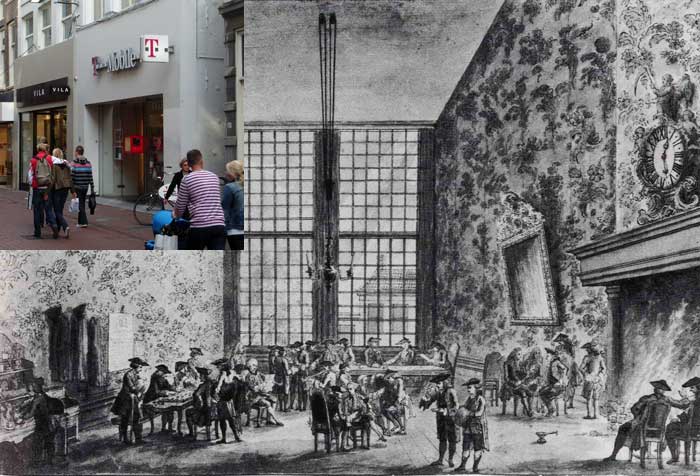
Needless to say that I was very curious what would be happening at our Wall Street here in Amsterdam. Beursplein 5. Would any of the protestors know that the square that they would be on, would be the design of a socialist and idealistic architect (Berlage)? And what would they protest about?
So I went there this afternoon and indeed there was some action. A whole podium was built. So I figured: my, my, this is an organised movement indeed. And I was impressed with this Occupy-Beursplein 5.

Then I looked a bit better. And I noticed the text. It read in big red letters: 'Stop by to consider rheumatism'. Perhaps that is somewhat typical of our Dutch willingness to revolt. Rather than occupying Beursplein 5 with protests against bank bonuses or other elements of greed, we occupy it with a rally to collect funds for people with a disease.
Would that be the Dutch way?
Update 1805: just found out via Twitter that I was three days early. It seems we need to wait for the beginning of our autumn holiday (this Saturday, 12 o clock) to start #OccupyAmsterdam...
22.8.11
The future of banking, as seen in 1969 by the BBC....
I just ran into the film below, by the BBC, about how computers can change our life as a bank customer. It shows a very basic point of sale transaction with a sort of modem and huge pinpad. It's interesting to see how the world changes in some 40 years.
14.7.11
History of Basel II and the effects since on banking...
I just read an interesting article on the history of Basel II, the set of rules that was established, some 25 years ago to make the supervisory rules for banking reflect more of the market dynamics than the previous set of rules. The article highlights that the zero-weighting prescribed for government banks, regardless of the country in which they were based, created a bias that made banks upload tons of government treasuries of a range of countries. It made banks lazy in doing a check on the counterparty risk, although there were serious differences in the quality of the debt. And it thus also provided easy (and cheap) money for the governments. We have since learnt that that is not a good thing and that governments cannot keep on borrowing money forever. See also todays warning and possible USA downgrade by Moodys.
The author of the article outlines that at this moment we can see the European Central Bank ignoring the rating agencies qualifications of countries debt to be able to continue providing liquidity to Portuguese and Irish banks. And he goes on to outline that it is quite likely that the future will consist of different Basel-rules, in which banks will have to do better due diligence and have to use realistic measures for counterparty risks.
That is, if we are willing to learn from history.
The author of the article outlines that at this moment we can see the European Central Bank ignoring the rating agencies qualifications of countries debt to be able to continue providing liquidity to Portuguese and Irish banks. And he goes on to outline that it is quite likely that the future will consist of different Basel-rules, in which banks will have to do better due diligence and have to use realistic measures for counterparty risks.
That is, if we are willing to learn from history.
4.7.11
Retronaut... .interesting site.... with history of Amsterdam in retro-foto's
Today I ran across a site on the web called the Retronaut. It is a site that aims to make pictures of the situation in a city right now and compare it to earlier days. And it has a special section on (the ghosts of) Amsterdam. And the interesting thing is, this method of making pictures on exactly the same spot as many years earlier is something I quite like doing. I don't have that much readily available on financial history however.
Except for one sketch of the desgn of the main office of the Nederlandsch-Indische Handelsbank, built between 1910-1912 and designed by architects: van Rossum and Vuyk. In 1925 the building was expanded by the architect van Gendt.

The building in 1962 turned into the head-office of the Municipal Giro of Amsterdam....

which in turn became the Main Post Office in Amsterdam...

which closed in January 2011 this year and now has space to rent....
Except for one sketch of the desgn of the main office of the Nederlandsch-Indische Handelsbank, built between 1910-1912 and designed by architects: van Rossum and Vuyk. In 1925 the building was expanded by the architect van Gendt.

The building in 1962 turned into the head-office of the Municipal Giro of Amsterdam....

which in turn became the Main Post Office in Amsterdam...

which closed in January 2011 this year and now has space to rent....
Subscribe to:
Posts (Atom)