Showing posts with label Amsterdam. Show all posts

30.4.25

Invention of Amsterdam - great book/walking tours - make sure to 'walk with Ben Coates'

Ok, so here's a straight up book and walking tip for anyone who visits Amsterdam and enjoys walking. Since a month you are lucky to be able to buy the book: The invention of Amsterdam: A History of Europe’s Greatest City in Ten Walks by Ben Coates to get to know Amsterdam better. From the first pages onward he draws you into how he got to come to the Netherlands, appreciate Amsterdam and appreciate walking in Amsterdam.

Now, we do walking tours on financial history in particular, but finance is always embedded in the bigger history picture. And Coates does a great job at telling this bigger picture about Amsterdam in the form of a range of walks through neighbourhoods. His writing style is great, amusing and contains fun lines where he compares what he describes about Amsterdam of course not to be a big secret. 

'Amsterdam and its glory years can only be considered 'unknown' or 'unexplored' n the same way that Tenerife might be described as a 'secret island' or the Rolling Stones as an 'undiscovered new band'.

Having lived in Amsterdam now for almost forty years, having worked at some of the offices in the Canal for over 6 years and having done so many walking tours for guests myself, it is fun to walk with Ben through my own town and enjoying his outsider/insider view. He remains the outsider in some ways, but is the insider in another way. 

His chapter on the second world war, the walk in the Jewish quarter covers very delicate ground and I was curious to see how he would discuss this very complex topic on very dark days in our Dutch history. Let me say I was deeply impressed. By combining facts, quotes and background information he also walks/navigates the reader towards a nuanced understanding of our history. 

The balance to be struck here is complex. Dutchies may not like the book or its writer and view it as a someone who is 'import', not from here and thus discount his findings/writing as being incorrect beforehand. But to me what the book demonstrates is the delicacy and care of Coates in dealing with the very harsh reality of our world war days. 

This is truly a very balanced, enjoyable and craftfully written book/walking tour guide that, to be fair, no true Dutch author could have written. Most Dutch are far more straightforward and lack his kind of delicacy and humour. 

So, it's a delight to see Amsterdam through Coates eyes and the book truly deserves a wide audience. And we will propose to the author to perhaps join hands and cooperate to turn one or two walks ino IziTravel tours

Ah, course, where to buy? You can find the book at the Guardian Bookshop or our local Dutch bol.com.

Enjoy the book and enjoy your stay in Amsterdam !


12.9.12

Sneak preview of the Amsterdam Waldorf Astoria: former head-office of Bank Mees and Hope (and NOB)

Next year, it is precisely 400 years ago that the Amsterdam city council decided to expand the city by creating canals. It is one of the very early examples of city planning and thus, the 17th century canal ring is officially listed as UNESCO world heritage site. Over time, the canal houses were the houses of rich families of merchants, bankers and slowly turned into the premises of banks.


Bank Mees en Hope hoofdkantoorThe Herengracht 548 for example, was the house of a merchant but later in its history turned into the head offices of the Nederlandse Overzeese Bank (NOB) and after the merger with Mees and Hope Bankiers: Bank Mees en Hope. Of course these head offices at the canals were something of a status symbol. But at the same time, the architects in the 1970s didn't hesitate to redesign a lot of the interior of the building, in order for the bank to be representative but productive as well.

This weekend I could take a look myself as the new owner: Waldorf Astoria, opened its premises during the Open Monuments Day. And so I could have a sneak preview from within a building that's still being renovated, that I am happy to share with you.

Have a look at: the green and beautiful garden (under which we find a parking garage), some marble pillars from the 1970s, the vault, still with safe deposits (which will become a bar), the period room, the beautiful hallway with sculptures and last but not least: the future front door of the Waldorf Astoria.


Front door of Waldorf Astoria Amsterdam

23.3.12

Blurring the faces of the statues at the entrance of the NHM building

I am currently busy contemplating different ways to share my passion for banking and history with the world. Not just this blog but also books and e-papers on the web. And while surfing about, I did notice a peculiar thing in Google StreetView. It happened when I looked at the Streetview for the front door of the Nederlandse Handel Maatschappij, located at the Vijzelstraat in Amsterdam:


I am not sure if you can see it, but in an effort to blur the faces of all people that accidentally make it to Google-Streetview, Google has decided to also blur the faces of the statues Europe and Asia.

But I am pretty sure that these ladies won't mind, so here's an unblurred version:


16.3.12

At the Amsterdam City Archive

There is great stuff to be found in the Amsterdam City Archive. I stumbled, for example, upon a foto series, made in 1998 to promote Amsterdam as the financial city centre. The Image Bank of Amsterdam has it all. See below:

18.11.11

Lessons from the crisis..... liquidity is the alpha and omega of a bank !

These days we are witnessing quite some turmoil in financial markets. Just as in the days after Lehman Brothers failed, the trust has gone. And with it the liquidity in the markets. Liquidity is also the underlying theme of the public hearings of the (Commission deWit 2) that these weeks occur in Dutch parliament.

Throughout the interviews it has become clear that the Dutch Fortis bank depended on the Belgium holding for its liquidity. And it did not have a big say/influence on the strategy of its Belgium holding. So when things went really wrong they saw the money move out and had little means of repairing/countering the liquidity outflows that were the result of the bad reputation that Fortis had gotten in the market.

In a slightly different case, ING incorrectly thought that the decline of value in Alt-A holdings in 2008 was due to lack of liquidity in the Alt-A market. They failed to understand in time that it was caused by a decrease in value and valuation. So just before they really needed it, ING got rid of what it considered 'excess liquidity' in the bank. To quickly discover that they did need that capital after all. Which lead to the State investing in core-tier 1 capital and to the illiquid asset arrangement for Alt-A.

The fact that sufficient liquidity is at the heart of each bank is of course not a new lesson for bankers. The Amsterdamsche Bank for example, was set up in 1872 just at a moment in time when the market slowed down. And rather than jumping in the market, the bank decided to remain quite liquid, forbearing possible 'temporary profits' as they described it in their first Annual Report.

So, going back some years to the year 1946, we can find one of the main lessons of todays public hearings, neatly formulated in the Commemorative Book on 75 years of Amsterdamsche Bank: 'The board of the Bank has, as we shall see later, accounted for the fact that under some circumstances even liquid assets such as collateralized 'prolongatiƫn' can become illiquid. Already in the first years of the existence of the Amsterdamsche Bank, the board has kept a keen eye on the the alpha and omega of a healthy bankpolicy: liquidity - which is safety for the creditor - and the Board has never in its 75 years diverged from this (policy)principle.'


6.11.11

Amsterdam in 1597.. very enjoyable book by van Tussenbroek

I have just finished reading the book: Amsterdam in 1597, by Gabri van Tussenbroek. Van Tussenbroek is a historian who works for the city of Amsterdam and this book described all the months of this important year. It's the year that the first boats came back from the Indies. But it is also the year that the survivors returned from their voyage with Willem Barentsz around the North Side. The book is written from the perspective of book publisher  Cornelisz Claesz and succeeds in giving the reader a sense of what living in Amsterdam must have been like. I can really advise anyone to buy, read and enjoy it !

The book also outlines that Claesz published a book (in 1586) with descriptions of the coins in circulation and use in Amsterdam around that time. Because money circulated in all forms and varieties, with one guilder of 1597 being the equivalent of about 13 euro today:
1 pond Vlaams = 6 gulden
1 gouden dukaat = 5 gulden, 5 stuivers
1 pond = 4 dukaat
1 pond = 20 schellingen
1 carolusgulden = geen mrekenmunt maar echte gulden
1 gulden = 20 stuivers
1 daalder = 30 stuivers
1 rijksdaalder = 50 stuivers
1 stuiver = 4 oortjes = 8 duiten = 16 penningen

Eventually, the variety of coins in circulation (of all kinds of countries) created a lot of confusion and merchants had to be very keen on checking the coins, weight etc in order not to be tricked by money traders. As a result, the city council decided to set up the 'Wisselbank', a girobank for merchants. This was done after the example in Venice, Italy. Any payment over 600 guilders had to be effected via the bank. Also the bank would exchange money and take any coin for deposit but only issue proper guilders when paying out (thus cleaning up the coins in circulation).


5.10.11

Where was the former city hall of Amsterdam....?

As some of you may know, the big building on the Dam now known as the Palace, used to be the city hall of Amsterdam. but for many years, Amsterdam had a smaller city hall that looked like this:


In the book by Pieter Vlaardingerbroek we can read that a visit of Maria de Medici in combination with increased self-awareness led to the decision to build a new city hall. And this new city hall soon became known as the 8th world wonder, as it was so huge and full of grandeur. Quite a number of buildings were taken down to be able to build the new city hall, so that leaves us with the question: where was the old city hall?

Well, luckily the book answers that question as well. It contains a map that shows the proper location.


So we can see that the city hall was actually close to the kalverstraat (on the left). If you draw a line from the kalverstraat to nieuwendijk, you would find the city hall right on that line.


13.9.11

View from the Bank, roof terrace Rembrandtplein, former Amsterdamsche Bank

This sunday, it was raining a bit more but just to give you an impression, here are two videos of the view form the roof terrace of the former Amsterdamsche Bank (now The Bank). Best weather and film quality can be found on this youtube clip:


And here is this weekends, mobile phone footage:


To close off with a link to the Parool-fotoseries.

1.9.11

Some more news on the headoffice of Amsterdamsche Bank on Rembrandtsplein

These days I have been chatting with some friends and former colleagues about the head-office of the AMRO-Bank (first: Amsterdamsche Bank) on the Rembrandtsplein. See also the former post. These chats were about the usage of the head-office.

When Amsterdamsche Bank merged with Rotterdamsche Bank, the two former head offices were both called main-bank (hoofdbank). So there was a hoofdbank Amsterdam and hoofdbank Rotterdam. The board of AMRO resided in the office at the Rembrandtsplein, until 1987 when they moved to the South-East part of Amsterdam. And from that moment on, the directors premises in the buildings remained unused. People sometimes were taken up with the special board-members elevator in the Parking, to the directors floor. And the reason that the floor wasn't used, was because it was considered inappropriate for personnel other than directors to re-use the former board-room floors/offices.

So then, in 1990 ABN and AMRO were merging to become ABN AMRO bank. But both of the two banks wished their headquarters to become the headoffice of the new merger bank ABN AMRO. But as they didn't give in, a compromise was found by re-using the former office floors of the AMRO-Bank at the Rembrandtsplein. And when in due time, the decision was made to build a fully new head office at the South-side of Amsterdam (Zuidas), the board could then agree to move the headoffice of ABN AMRO to the AMRO building in South-East Amsterdam (Bijlmer).


26.8.11

Rembrandtsplein: Amsterdamsche Bank, Incasso Bank, Amro-bank, ABN AMRO Bank en nu the Bank

In 2 weeks time, many monuments in the Netherlands will be open to the public as a part of the National Open Monuments Day (Open Monumentendag). This years motto is 'Old building, new destiny', and aims to let the public discover how old buildings get a new destiny. I signed up to be a volunteer for the Amsterdam Monument Days and will be helping out as a guide in the Bank on Saturday the 10th and Sunday the 11th of September.

As a part of my preparations I tried to get a grip on how the Rembrandtsplein developed over the years and how the Amsterdamsche Bank evolved over time. I discovered that the area of the Rembrandstplein where they built the Amsterdamsche Bank was previously called the Kippenhoek ('chickens corner') due to the presence of the chicken-market there. And I picked up some older photo's from that area.

 Here is the Kippenhoek in 1880:


And here is the same location some 44 years later, in 1924:


In that time, discussions occurred that lead to the design of the new head office of the Amsterdamsche Bank. This coincided with a change in the traffic routing on the Rembrandtsplein. More area was needed to allow cars and trams to pass by. So this paved the way for some changes. Father and Son OuĆ«ndag worked together with Berlage to design the new head office for the Amsterdamsche Bank. They got all their sorts of permissions, so in december 1926 only a small part of the former buildings in the Kippenhoek remained:
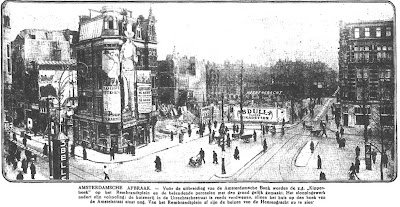

Then, the Amsterdamsche Bank was built. On the ground floor area, there were no shops, but very small windows. And even before its realization there was some discussion about it. One merchant had argued and written to the city council that, since the Amsterdam city also had to sell some pavement to the Amsterdamsche Bank, this should be sold for a price of 250 guilders per m2 with the condition that shops or window displays should be added to the design, in order to make that side of the Rembrandtplein a bit more open. The votes on this issue were insufficient however. So here we see the finished building in approximately the same direction:


We should note that this building was close to the Turfmarkt where the central bank was located and also near to the stock exchange building on Beursplein 5. And it could be considered a smaller cousin of the other new bank building in the Amsterdam city centre: the Bazel (headoffices of the Nederlandse Handelmaatschappij). Both buildings marked a change in building styles for banks.


Over the years, the Amsterdamsche Bank merged with Incasso Bank (a takeover) and a merger with Rotterdamse bank lead to the AMRO-Bank (AMRO for Amsterdam-Rotterdam). And the head office of the AMRO-bank had to keep up with the growth. So in the 1970s the architects Zwiers and Fontein doubled the volume of the building by adding a roof ('the tent camp' in ugly white duplex), closing the atrium inside and replacing it with regular floors and by adding the neigbouring buildings. In particular the addition of the extra roof on top of the old building led to quite some protests in the city.


In 1987 the AMRO moved its headquarters to the South-East side of Amsterdam and thus became one of the first banks to initiate a move away from the prestigious city centre. As the bank merged with ABN, it became ABN-AMRO. And around 2001, ABN-AMRO decided to sell off its buildings in the city centre. Which lead to the question, what to do with the building.

A number of plans passed around the table (among which the idea to make a huge hotel) until the Kroonenberg Groep decided to invest heavily in making it an up-to-date building. Aided by architects Kees Rijnboutt en Frederik Vermeesch they have done a great job in restyling the building. This wasn't easy. At first they wanted to kick-off the ugly tent-camp in top, but as it was part of the historical elements of the building, it had to remain. So they decided to change the material and throw in quite some changes to make the building fit in the surroundings better (see their website for a number of articles about that- in Dutch).

One very clever thing they did, was open up the former Atrium inside, letting the light back in. This immediately gives the building much of its grandeur and openness.


And some 90 years later, the Amsterdam merchant has his way. The area at street level on the Rembrandtsplein is now more open, with shops for the public (Marqt, George, Amsterdam Experience). And in number of technical details, the architects have really done justice to the soul of the building. So, although the statue of Rembrandt still has his back turned to the building, I think it is fair to say that this is a very nice restauration:


But it wouldn't be fun if there was no mystery left. And the remaining mystery of the building is the Mosaic below. The architects have been unable to determine who made it or gave it or added it to the building. And I myself am also quite curious. So anyone who knows... please let me know.


4.7.11

Retronaut... .interesting site.... with history of Amsterdam in retro-foto's

Today I ran across a site on the web called the Retronaut. It is a site that aims to make pictures of the situation in a city right now and compare it to earlier days. And it has a special section on (the ghosts of) Amsterdam. And the interesting thing is, this method of making pictures on exactly the same spot as many years earlier is something I quite like doing. I don't have that much readily available on financial history however.

Except for one sketch of the desgn of the main office of the Nederlandsch-Indische Handelsbank, built between 1910-1912 and designed by architects: van Rossum and Vuyk. In 1925 the building was expanded by the architect van Gendt.


The building in 1962 turned into the head-office of the Municipal Giro of Amsterdam....


which in turn became the Main Post Office in Amsterdam...


which closed in January 2011 this year and now has space to rent....


1.7.11

Visit to the Jewish Historical Museum... fine example of a modern museum

Yesterday I had the pleasure to visit the Jewish Historical Museum in Amsterdam. And I very much enjoyed seeing both the regular expositions and the temporary ones on Dada, Triumph of Identity. It had been quite a while since my previous visit and I was pleasantly surprised. The museum has chosen to focus on the Jewish identity and history in a way that is really inviting and allows for both a more quick overview or a more in depth listen/view to video's and audiotapes. And in doing so they also managed to avoid the risk of becoming a war-museum.

To me it became more clear that since the 16th century the Dutch were a bit more open towards the Jewish people than other countries in Europe, making Amsterdam a better place to stay than other cities in Europe. Still, jewish people weren't allowed into the guilds and sought out jobs as diamond cutters and were active in (street) trade and finance. And I came to understand that Hugo de Groot helped out in outlining which legal rules to apply to jewish immigrants, using the point of view that we should welcome the jewish people to the Netherlands, not so much for the experience in trade or their economic benefit, but for the mere fact that they are human. Imagine that later on, de Groot got in trouble for his liberal point of view (that didn't suit the Calvinist yoke).

I didn't know that it took until after the French revolution that the jewish people officially obtained equal rights. And with that came an obligation to also use the Dutch language. Which was supported by some in the jewish community, but strongly resisted by others. It allowed me to further understand and reflect on being away from home and having to find a place of your own. The way in which the museum helped me look at this history and development of identity was very inspiring.

As the last bit of my tour around the museum I came to visit the Kids Museum. And it would of course be easy to leave it aside and visit only the grown-up stuff. But I didn't and thus entered the home of a family. The visit takes you through the different rooms of the house, allowing for different aspect of tradition to be highlighted. Which is all down in very bright and open manner. With a sort of Harry-Potter like speaking wall, which tells the kids the history of the building. And a music room upstairs, which helped out understanding the different jewish celebrations.

All in all, I found the museum is a real treasure that we may be really be proud of.

27.6.11

First ATM installed 44 years ago ....

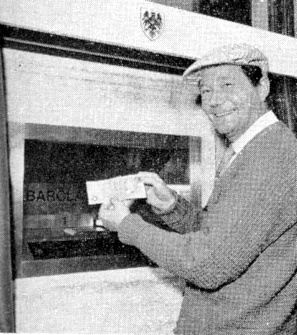
In this article, you can read that 44 years ago, the first ATM was installed by Barclays Bank in Enfield, North London. And there's a picture of that moment remaining, as Reg Varney (who played in the serie On the Buses) was asked to help out in the publicity.


Of course this development was for some time on its way. And the Dutch banks and Postal Giro Services started considering using the ATM as well. Thus, one year later (1968) the banks ABN, AMRO and NMB, started out a trial with a so-called Bank-o-maat at three banks. The ABN AMRO Historical Archive was so kind to provide me with a picture (they actually also have the actual machine somewhere in the cellars) of that machine.

The introduction of the trial was accompanied by the following article in the Amroscoop of June 1968, outlining the workings and details. It was a machine by the Swedish company Metior AB, placed by LIPS N.V. See also (in Dutch):

In the same year (1968: details forthcoming) the Postal Cheque and Giro-Services (PCGD) held a trial with an automated teller machine in Alphen a/d Rijn. I don't have a picture but somewhere hidden in my archive I do have a many-pager evaluation report on its features and future applicability for the PCGD.

Also I am aware of one other trial in 1972, where the Algemene Bank Nederland trialled a Burroughs machine in the Vijzelstraat 20 (which was for internal personnel only).

The first ATM however, to be used  for regular customer purposes (not as a trial), was introduced by the former Gemeentegiro Amsterdam (GGA) in 1976. The director of the GGA, Stofkooper, had by that time most likely some hunch that some point in the future he would inevitably have to merge with the bigger Postal Giro Services. So he decided to invest heavily in all new technologies and equipment, to make sure that his bargaining position was as good as possible. And as a result the GGA was also one of the first institutions to have a well functioning on-line verification network between remote-offices and headquarters.

17.6.11

Schama in Amsterdam: what todays bankers may learn from financial history

Today I visited the conference of the Amsterdam Financial Forum, with Simon Schama as one of the speakers during the morning. The excellent programme led to animated discussions on the role of banks now and in the future. And for me, Schama's insights were the icing on the cake. So I wrote down some of those insights in order to share them with a wider audience, interested in (lessons from) Amsterdam financial history.


Things aren't back to normal: financial history is highly relevant for todays bankers
Schama started out by explaining that financial history is absolutely relevant for modern finance and banking. And being in the city of Amsterdam he of course pointed out the Wisselbank and the East India Company as notable achievements, to continue with some light touch observations about the people in the room (95% bankers). He positioned himself as the man from the 'real world out there', landing on the planet where bankers reside and warned that bankers are often discussing all kind of relevant future developments with themselves (he coined this: 'echo chambers'). Schama warned the bankers that the last thing they had to do was to go back to 'business as usual'. Because todays society is not back to a usual state of being, given for example the democratisation process in the Middle-East, the trouble in Greece, Ireland and Portugal as well as the social unrest and public anger at banks. Things aren't normal at all and history can help bankers get a better grip on the developments and possibly an outlook for the future.

Amsterdam history learns: money, prudence and charity went hand in hand
Schama offered abundantly from his historical knowledge and clarified the audience that during the 17th century, in Amsterdam, there was also a lively debate about what constitutes a good banker. He cited Godfried Udemans and Erasmus (who wrote a comedy of the rich) and William Temple (Observations upon the United Provinces of the Netherlands) as writers that discussed the morality involved when accumulating money. Schama explained that along with the growth of wealth in Amsterdam came the growth of caretaking institutions such as schools, housing for widows, the eldery and so on. And he noted that at that point in time, the accumulation of money went hand in hand with charity and caring for the weak in society.

Which brought the audience to lesson number one -so to say- which is that if we want to learn from Dutch financial history, we can for example learn to not only fix our eyes on the money, but also share the accumulated wealth with  the weak and needy in society. During his talk and comments Schama repeatedly outlined that -in contrast with earlier times- todays societies cut down on the medicare, schooling and similar public sector activities while mainly focusing on making money. A solid (and worrying) observation.

He outlined that Amsterdam in the 17th century made a strong distinction between deposit taking at the Wisselbank and loans at the Bank van Leening (Lombard-bank). So there was a definite awareness about what (not) to do with deposited money. In a similar line of reasoning he pointed out that later on in the 18th century, banking in the Netherlands came down to wealth management ('rentenieren') and that this activity did cost the Dutch quite some money as their business was concentrated to much on some risky governments (French..). Although the real bleeder in financial terms was the war against the French.

The crisis demonstrates that banks owe the public something and need to redefine their position
As a part of his plea for a more fundamental rethink of the relationship with society, Schama explained that in essence casino finance had brought down the economy. As a logical consequence governments have stepped in with public money. And the public thus rightly feels that they are paying for and cleaning up after the banks. Which has lead to a situation with social unrest and an angry public. He warned that in response to this generic angry feeling, banks currently face a serious challenge to redefine their relation to the angry world. And banks should not behave -business as usual- as if they are living on planet elsewhere by rearranging the deckchairs on the Titanic. A fundamental, constructive forward-looking ethical self-reflection by banks is needed and it is needed now. Is there any other or better time? If banks do not respond to this challenge now, .... when?

While I wholeheartedly agree, I couldn't help but notice that the more abstract and ethical call for action may not have landed completely with the audience. It appeared to me that most of the audience were essentially quite involved and busy in trying to implement the current new regulations (as a follow up to the financial crisis). And I have the impression that some of the banks also view this bunch of implementation work as the operational action following this ethical call for action. Yet, Schama's call went beyond just that. Essentially he put the ethical question on the agenda: if you make money with money, you cannot (as banks) simply claim or reap the full benefits of that but you should also pay dues to society. And how are you banks going to do that...?

On Europe: either the politicians show leadership or the populist trend kills the euro
Later on that day, there was a discussion about the future of Europe, given the financial trouble in Greece, Ireland and Portugal. Schama outlined that in his view European politicians should not only solve the immediate issues at hand, but should do more. He suggested that a European convention be held, similar to for example the Bretton Woods convention, in which fundamental choices and direction was made for the future of Europe and the role of its constituting nations. Such a joint European vision would help the public in all Member States understand what we are doing in Europe and why. And it is of course be up to the current politicians to show leadership in developing this vision. Because without it, the alternative might well be that in the countries of Europe the populists like Marie lePen would gain the upper hand by demolishing the euro from the inside.


Simon Schama's speech at the Amsterdam Financial Forum 2011 from Ernst & Young on Vimeo.

Whereto now?
With an abundant, varied and excellent line-up of speakers, the conference provided both practical and more fundamental avenues of thought for the best future of financial services. And I am quite curious where we will stand in one years time. So I can only hope that the Amsterdam Financial Forum will indeed become a tradition and that the initiators of this event:  (Ernst and Young and Holland Financial Centre) and the sponsors (Stock Exchange Association FoundationCapital Amsterdam and Amsterdam in Business) will choose to hold it again next year.

31.5.11

ING Eliminates savings accounts

ING is these days kicking out all old savings accounts. Among those, the infamous: Rente, Plus and Sterrekening. These were the first savings accounts of the Former RijksPostSpaarbank that merged with the Postal Giro services (PCGD). The accounts were linked to the giro-account and worked as the savings account with the same number. And the names of those accounts was symbolic of course:
- Rente
- Plus
- Ster
creating a acrostichon for RPS, so that the name RPS would live a long time after the merger.

Until this year that is, because the technology of the 20th century is not just that flexible in the 21th.

14.5.11

The beginning of this weblog....

All things in life start somewhere. And this blog starts here as an extension of my interest in history and financial history in particular. I think I attracted this 'virus' in my first job back in 1989. I started working at the Postbank, which was then just privatized as a bank, independent from government. And I noticed the colleagues at the Postbank had a strong sense of pride and history. Through them I got to know about the Postal Savings Institutions, the history of the Postal Cheque and Giro Services and the Municipal Giro of Amsterdam and so on.

As the virus caught on I discovered that Amsterdam may pride itself as having founded the Amsterdamse Wisselbank for example, a giro-bank modelled after the Italian examples. And of course there is the Stock Exchange and the Dutch East India Company. And already in early days Amsterdam welcomed such famous visitors as John Law, who also left quite some traces in financial history.

While I am currently busy on contributing my fair share to the Dutch financial history (by writing a book on the development of the Dutch payment industry in the 21st century) I am also setting up a financial history tour in the centre of Amsterdam. Because what makes Amsterdam unique is that you can literally walk through financial history in a 2-3 hour tour. And as much as I enjoy sharing that history, I hope visitors will enjoy hearing and reading about it here.

So if you're coming to Amsterdam and you would be interested, drop me a note.