Showing posts with label ABN. Show all posts

23.3.12

Blurring the faces of the statues at the entrance of the NHM building

I am currently busy contemplating different ways to share my passion for banking and history with the world. Not just this blog but also books and e-papers on the web. And while surfing about, I did notice a peculiar thing in Google StreetView. It happened when I looked at the Streetview for the front door of the Nederlandse Handel Maatschappij, located at the Vijzelstraat in Amsterdam:


I am not sure if you can see it, but in an effort to blur the faces of all people that accidentally make it to Google-Streetview, Google has decided to also blur the faces of the statues Europe and Asia.

But I am pretty sure that these ladies won't mind, so here's an unblurred version:


16.1.12

The evolution of commercial banking in the Netherlands (rise and demise of ABN AMRO)

While preparing for a lecture on bank history, I ran into this excellent working paper by Joost Jonker that summarizes the history of commercial banking (read: ABN AMRO). It's title is: Scale at any price and its subtitle: The rise and predictable demise of ABN AMRO, 1960-2006.

It describes how the essential flaw for ABN, AMRO and ABN AMRO was that the company did not pay sufficient attention to creating a sound cost- and funding basis. Although the retail part of ABN AMRO grew considerably in the 1970s, the cost/income ratio was left unattended and it never really grew into a universal bank. So in the Netherlands the company became a conglomerate of business lines with little insight into its own cost-structure. And then after 1990 the company chose to further expand, while it's internal house wasn't sufficienly in order.

Jonker describes a picture of a company that is unable to get its fundamental operations and cost/income under control, and concludes:
These elementary mistakes were compounded by the profound mismanagement under which ABN AMRO suffered from 2000: the wilful changes of strategy, the continuous and pointless reorganizations, the inability to cut costs, the ludicrous and expensive pretentions of global excellence. Unable to keep pace with its self-defined goal, the top echelon of international banks, ABN AMRO forced itself into a continuous flight forward, justified by apocalyptic visions of an imminent endgame. When that end seemed near the board rushed ahead to get the best deal possible, arrogantly thinking it could control what was really a sell-out.

By now we know the consequences: A sell-off of south American and Italian business to Banco Santander. A take over of the Dutch wholesale-activities by RBS. But RBS, it turned out, was at that point in time not fully ready (or able) to execute such a takeover, according to the FSA. And similarly, Fortis made a leap of faith when choosing to take over ABN AMRO as a member of the consortium. So Fortis ended up being saved by the Dutch state, with the condition that the former HBU-activities be sold quickly (to Deutsche Bank it turned out).

The whole process is one of creative destruction (as Schumpeter would call it). Which essentially means that  there is a re-assembly of old businesses into new forms/shapes. For the banks involved, it means they are going back to basics, re-orientating towards solid cost/income ratios and customer satisfaction in a renewed competitive landscape.


27.6.11

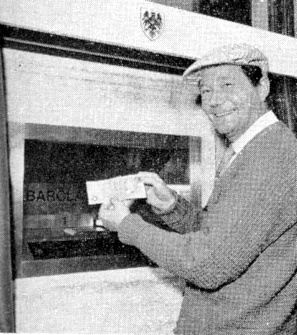
First ATM installed 44 years ago ....

In this article, you can read that 44 years ago, the first ATM was installed by Barclays Bank in Enfield, North London. And there's a picture of that moment remaining, as Reg Varney (who played in the serie On the Buses) was asked to help out in the publicity.


Of course this development was for some time on its way. And the Dutch banks and Postal Giro Services started considering using the ATM as well. Thus, one year later (1968) the banks ABN, AMRO and NMB, started out a trial with a so-called Bank-o-maat at three banks. The ABN AMRO Historical Archive was so kind to provide me with a picture (they actually also have the actual machine somewhere in the cellars) of that machine.

The introduction of the trial was accompanied by the following article in the Amroscoop of June 1968, outlining the workings and details. It was a machine by the Swedish company Metior AB, placed by LIPS N.V. See also (in Dutch):

In the same year (1968: details forthcoming) the Postal Cheque and Giro-Services (PCGD) held a trial with an automated teller machine in Alphen a/d Rijn. I don't have a picture but somewhere hidden in my archive I do have a many-pager evaluation report on its features and future applicability for the PCGD.

Also I am aware of one other trial in 1972, where the Algemene Bank Nederland trialled a Burroughs machine in the Vijzelstraat 20 (which was for internal personnel only).

The first ATM however, to be used  for regular customer purposes (not as a trial), was introduced by the former Gemeentegiro Amsterdam (GGA) in 1976. The director of the GGA, Stofkooper, had by that time most likely some hunch that some point in the future he would inevitably have to merge with the bigger Postal Giro Services. So he decided to invest heavily in all new technologies and equipment, to make sure that his bargaining position was as good as possible. And as a result the GGA was also one of the first institutions to have a well functioning on-line verification network between remote-offices and headquarters.