Showing posts with label Berlage. Show all posts

5.8.16

'Duur uw uur' and 'Beidt uw tijd' : what do these words on the tower of the Beurs van Berlage mean?

Beidt uw tijd - Text on bell tower of Beurs van Berlage
One of the many questions we get asked about the history of the Beurs van Berlage, is the meaning and significance of the words underneath the clock of the bell tower.

Starting with a literal translation, the words come down to:
- Duur uw uur - As long it (your hour) takes
- Beidt uw tijd - Bide your time
and we can already guess that the words contain some sort of message to the spectator.

Yet, as this is the well-designed Berlage Exchange Building, there may be more to it, so let's explore this a bit further.

Integration of architecture and art
The architect Berlage designed the building in close cooperation with artist/poet Albert Verwey and the latter formulated a storyline that underlies the design and use of the building:
1- a historic overview of the development of trade in Amsterdam and the Netherlands,
2- a logical utopian perspective: money, trade and classes would in the future fully disappear.

These elements are aligned with:
1- the projected use of the building as a home to the commercial exchange, the stock exchange, the shipping exchange and the grain exchange,
2- the use as a public building in the far future (when the utopian society had arrived).

The poem: the Tower
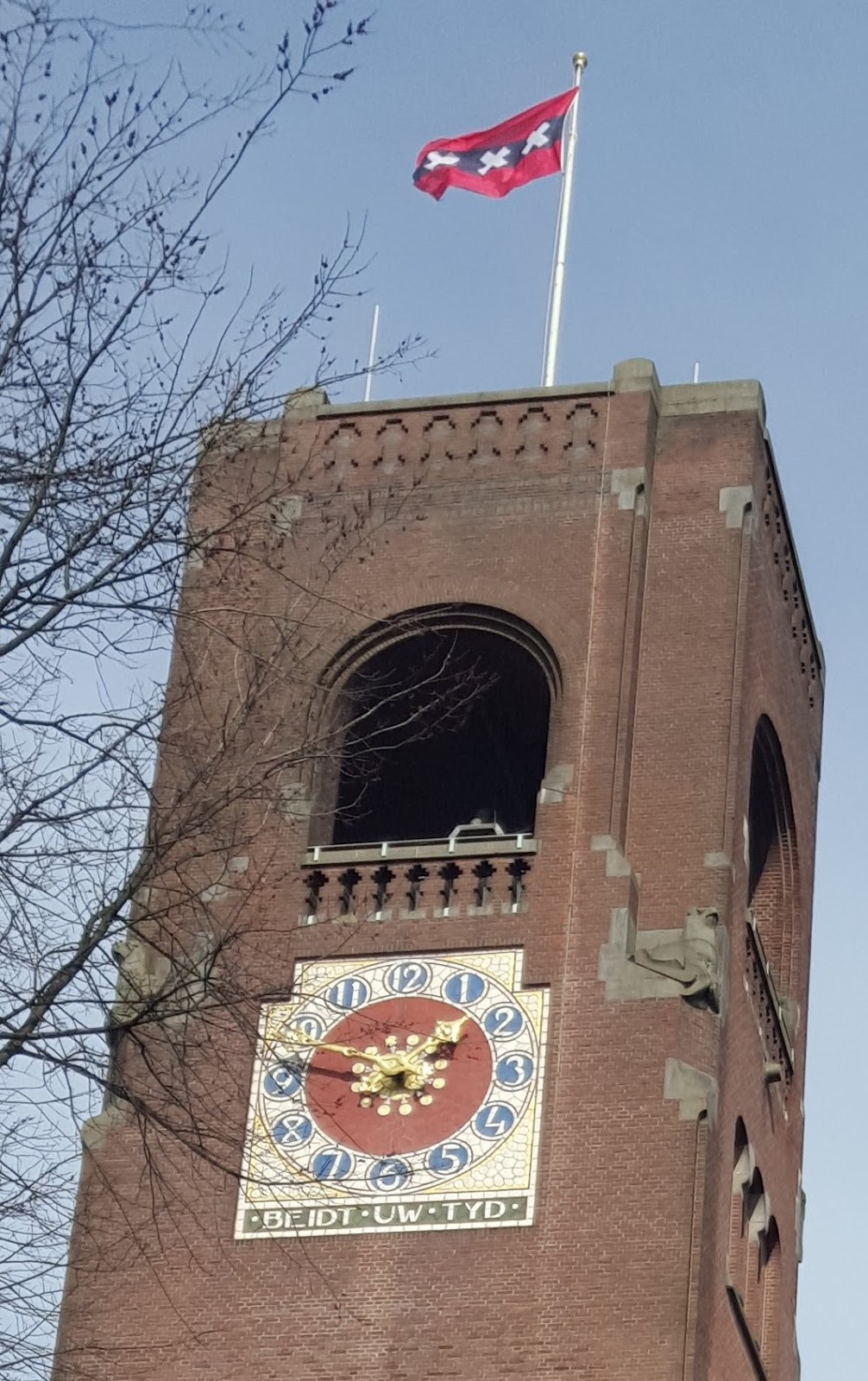
Beidt uw tijd - Bide your time
For the bell-tower, Albert Verwey wrote a specific poem, which Nicolien Badura re-published on her blog:

De toren sprak naar de stad gewend:
Gij burgers, die daar jaagt en rent,
Sta stil als ik en beidt uw tijd,
Zij die geloven, haasten niet.
De goede en sterke daad geschiedt
Te rechter uur, den tijd ten spijt.

De toren spreekt tot iedere vreemd
Die naar de stad zijn richting neemt:
Sta vast als ik en duur uw uur.
Wie op zijn kracht niet vol berust,
Wiens ijver halfweegs wordt geblust,
Houdt hier geen stand, heeft hier geen duur.

The first part of this poem is about the part of the Tower that is looking towards the city, with the wording: bide your time. The second part is about the side of the tower that faces Amsterdam Central Station: the place where all visitors enter Amsterdam.

The poem- translated:
A free translation of the poem reads:

The tower speaks to those in town
Thou citizens, rushing and running around
Stand still, just like me and bide your time
Those who believe, do not rush
The good and strong feat happens
At its proper time, in spite of time

The tower speaks to each stranger
That heads towards the city
Stand firm, just like me and as long as it (your hour) takes.
Those who do not rely on their strenght
Whose zeal halfway is extinguished
Will not last, will not endure here.  

Taking the poem literally, we can see that the clock warns the cities inhabitants not to rush things but to rest assured that good things will come at their own time. So it's better to wait for the right time than to rush it. It could be viewed as a call to relax, to chill. Things will turn out fine in the end.

To the strangers, the clock says: if you wish to make it here in Amsterdam, make sure to rely on your talents and energy and persevere in your efforts. You won't make it here, unless you keep on pursuing your goals. 

Poetry in motion
The beauty of poetry is of course that all oother kinds of explanations of the poem might have been spinning around in the mind of its creator, Albert Verwey. We won't know and there's no need to. With poetry, as will all art, the creation can take up any meaning; so it's all up to us as readers.

Personally, I can also imagine the following additional layers of interpretation:
1 - hints at the design and building process itself. 
There was a very long time involved from architecture contest towards the opening of the building and the first part could be viewed as the building itself saying: At last, I'm here, I'm the good and strong feat that came into existence in its own time (not the projected/expected time). Similarly the second part of the poem would reflect the fact that the building/tower is well built, strong and will last a long time.
2- is directed towards the traders at the exchanges. 
The poem could be viewed as a call to traders not to rush into trades but to time their transactions properly (part 1) and persevere in their business (part 2).
3- reflects the utopian perspective, mentioned earlier.
In this vision, the first part of the poem would refer to the vision that over time the world will become a society without class distinctions and trade/money. At that point in time, the tower would still be there and the building could start its second life as a public / communal building.

So what do you think?
Feel free to share your insights with us via Twitter: @finerfgoed.

28.1.15

Minister of Finance Dijsselbloem ends reign of incrowd-supervisory-model for Authority Financial Markets

The last couple of weeks, the Dutch Financieele Dagblad reported on the fact that our Minister of Finance, Jeroen Dijsselbloem, had actively intervened in the workings, nominations and appointments of the Members of the Supervisory Board for the Authority Financial Markets. The dynamics of the case have a historic relevance that I would like to highlight in this post.

Incrowds at the Amsterdam exchange
The Amsterdam exchange, which has a long history going back to the early 17th century, has since its start been an open exchange. All who wished could enter the exchange and do business. But specialisation happened over time. Brokers existed, that were licensed intermediaries that could help out the incidental exchange visitor to find the proper counterparty.

As centuries went by, the specialist incrowd of traders on the exchange favoured an exchange were not just anyone could come and do business, but only licensed or vetted members. The city council of Amsterdam opposed this principle, but had to give in once the Berlage exchange building was in place. The building allowed for a physical separation and access control which provided the traders their own space, with their own rules. Papers report that even police men were pushed out of this space as the traders considered it their own land/country/turf/territory with its own rules.

The cherry on the cake, for traders, was -in 1914- the move to the Amsterdam Exchange building at Beursplein 5. They had their own rules, their own building and -of course- their own governance rules. A self appointed group of professionals was assigned to supervise trading and the trading rules. Eventually this was organised in the so-called Foundation Supervison Securities Trading (Stichting Toezicht Effectenverkeer). Of course, only in-crowders were appointed to be board members.

From self-assessment to a formal supervisor
As of March the 1st, 2002, the actual supervision of the stock exchange is in the hands of the Authority Financial Markets. This is an independent government body that has since grown into the so-called conducht-supervisor. It supervises conduct of players in the financial markets, and has expanded its reach to also supervise accountants, intermediairies, investment funds and so on.

The composition of its board of supervisors has varied over the years since 2002, but there was one remarkable choice in 2010. Minister Bos chose to appoint George Muller, formerly executive with the Amsterdam Exchange (which became Euronext) as the chair of the board. This was remarkable as the stature of Möller, in my view, was disputed. Möller had previously agreed on becoming the boss of Euronext at some stage and when he didn't land that job, he quit at Euronext to work for Robeco instead.

Although anyone is free of course to make such a career move, it does tell the observer that this person attaches quite some value to prestige and may be someone with a bigger need of attention. Also, one could argue that it is good to have a former insider in the Board of Supervisors of the Authority Financial Markets. On the other hand, it is once again a choice for the senior white male, rather than a competent female professional. It also doesn't take on board the fact that the role of the AFM grew bigger than a mere markets-supervisor.

An end to the era of old-school-male incrowders
Internal discussions within the Supervisory Board of the AFM gradually hit the news and revealed that the male Board Members were more flexible as to rules with respect to side-jobs and obligations than the female Board members. One of the female directors that missed out on a re-appointment had a regular exit-interview at the Ministry of Finance. This lead to further investigations into the workings of the board, side-jobs and so on.

The Minister of Finance decided to reshuffle the board of supervisors, some of them left and the Ministry motivated the board to appoint Merel van Vroonhoven as the new director of the Authority itself. This is quite an intervention indeed. When seen from a historical perspective however it is a measure that was long overdue. It is an appropriate end of the era of old-white-male stock exchange traders-incrowd that make up and play by their own rules, regardless of the interests of society.


30.12.13

All 2013 activities for Financial History of Amsterdam

Launch of digital museum 'Financieel Erfgoed op de Kaart'
Financieel Erfgoed op de Kaart2013 started out with the launch of our digital museum on Financial History. It is called Financieel Erfgoed op de Kaart and is a website that contains the stories and lokation where financial history happened. The site can be viewed on the desktop, in which case it looks like a rich google-map, or via the mobile. The mobile is sensitive to the location and will show the nearest hot spots of history as well as a responsive mobile menu. The launch was covered in both national and regional media and has a steady flow of visitors ever since.
Boat- and walking tours
We organised several taylor-made walking tours on the financial history of Amsterdam for visiting US Students, Norwegian insurers, financial supervisors, Nyenrode college students, employees of Booking.com and the Dutch Ministry of Economic Affairs. On top of that we introduced a boattour on the financial history of Amsterdam, for two large organisation in the financial sector. 
April: Filosofy night on guilt and debt
In april of 2013, the Filosofy night was dedictaed to the theme of guilt and debt. We presented an overview of history and future of money with the title: “Back to the future”. In addition we joined a radio show conversation with Werner Trio of Radio Klara on the topic of money and value.
The Filosofy Night occured in the former Exchange building: 'de Beurs van Berlage'. This inspired us to dedicate a separate part of our virtual museum on the financial history to this site. Since then, all visitors of the Exchange building can use their mobile phone to have a look at the financial history of that building
Lectures/workshops/blogs
We wrote some guest blogs. One was about Leviathan for Felix Meritis, the other was a blog on the hands, swearing an oath, at the Amsterdam Museum site. Apart from that we regularly published in the online-blog of the Dutch Financial Newspaper: het Financieele Dagblad. We presented an unknown story of Amsterdam's city giro for a festive event in June and held a workshop on the future (and past) of money for a large financial institution.
Radioshow: Casa Luna
To end the year, we were asked to join the Dutch radio show Casa Luna to talk about the history of money, alternative payments and the current situation in the banking sector. This was a very inspiring two hours of discussion, with a nice deviation to the role of artists and their capability to point out the faults in the financial system, way before supervisors acted. 

2014: pubquiz and walking tour apps
In 2014 we will continue sharing our passion for financial history with all visitors to Amsterdam. We will develop a pub quiz on financial history and launch an iTours app on the financial history of Amsterdam. It will show pictures from the city archive and allow you to experience the history in your own pace. 

We look forward to seeing you in the new year !

29.3.13

Morality meets money on Filosophy Night (12th of April) in Amsterdam

Morality and Money. Two concepts that are - whether you like it or not - infinitely intertwined. As we witness European funds and cash being sent to Cyprus, we can also observe that a number of conditions are attached which seek to address concerns as to the 'tax haven shelter' or money laundering nature of its financial sector. In a similar way it is impossible in todays Dutch society to cheerfully announce anything on the topic of bonuses, without ending up in a moralistic debate. But the link between morality and money is far deeper than that.

On the evening of the 12th of April, the Beurs van Berlage in Amsterdam becomes the venue of the so called Philosophy Night. It's an evening organised by the Dutch Philosophy Magazine and has a dense programme of lectures, discussions, interviews that all revolve around the relation between money, philosophy, morality and guilt. Visitors will be able to choose among many sessions to discover the views of philosophers, journalists, bankers, politicians and artists. While most of the programme is in Dutch, the English-spoken part of the programma itself contains a very nice line up with Michael Sandel, Thomas Sedláček, Jules Evans and Donna Dickenson.

Sandel is of course well known for his college sessions on Justice and the moral limits of markets (on which he wrote in: What Money can't buy) and he will be the main guest that opens the evening. Later on, that night, Tomas Sedláček will give a presentation on the main theme in his book: the Economics of Good and Evil. He argues that economic discussions are so intertwined with culture, art, philosophy etc that discussions on economics boil down to questions of good and evil.

Jules Evans, author of the book Filosophy for Life, will be discussing how the Stoic way of thinking may be helpful in liberating ourselves from the chains of commerce and the addiction to money, power and status. And finally Donna Dickenson will be interviewed on the subject of selling body parts for money. What are the practices, how far can this go, should there be a limit?

The fact that these subjects are discussed in the Berlage Exchange Building is quite symbolic by the way. It's designer, Berlage, has chosen to translate his and Albert Verweijs view on the future development of society into the artwork of the building. And that view was that there would be an inevitable further development from an industrial society to a new society in which money and trade no longer exists and man/women live equally and happy ever after. So even the building is engaged in the debate of that night.

To see this, just look up when entering the building, on the 12th of April and you'll see a carving in relief of people grouped together. Below are the verses by the poet Albert Verweij which (translated) say:
`The earth will soon be one: its peoples are groups all,
forming one great union the wide world round.
Ships on the sea advance, trains over land
to varying ends as they go they call'.

See for more info the English Page of Philosophy Magazine here.

14.1.13

Financieel Erfgoed op de Kaart: opening digitaal museum over financiële geschiedenis

Vandaag lanceer ik officieel de site: 'Financieel Erfgoed op de Kaart'. Dat is een online 'virtueel' museum, dat de financiële geschiedenis van Nederland ontsluit op basis van de lokatie (Google Maps). De verhalen uit die geschiedenis zijn te vinden door in te zoomen en te klikken op de i, of door het menu rechts onder Amsterdam verder uit te vouwen en een informatiepunt te selecteren.

Ik heb Financieel Erfgoed op de Kaart gelanceerd om de verborgen verhalen uit de Nederlandse financiële geschiedenis op één plaats te ontsluiten en bewaren. Overal in het straatbeeld zijn namelijk nog sporen te zien van de financiële geschiedenis. Maar de verhalen erachter zijn niet altijd meer bekend, terwijl ze toch nog steeds boeiend en relevant zijn.
Foto: P. Louw, 2005
Neem bijvoorbeeld de Munt in Amsterdam. Dit gebouw is slechts één jaar in gebruik geweest voor het slaan van munten. Het gebouw brengt ons terug naar 1672 waarin Nederland onder de voet werd gelopen door Frankrijk, Engeland en twee Duitse prinsen.

 In feite bleek toen dat Nederland, als klein land, voor haar zelfstandige voortbestaan altijd erg afhankelijk is van de omringende landen en er het beste aan doet zich te voegen naar de dynamiek van de grote buurlanden in Europa: een inzicht dat ook nu nog steeds relevant is.

Op www.financieelerfgoedopdekaart.nl kan een bezoeker vanachter de PC thuis een 'wandeling' door het financieel erfgoed maken. En wie zélf op pad in Amsterdam is en de site op de smartphone opent, ziet de informatie over de meest nabije historische plaatsen getoond in een menu. Ook kan de augmented-reality toepassing Layar worden gebruikt. Op dat moment fungeert de stad feitelijk als openluchtmuseum.

In dit digitale musuem staat het verhaal van de financiele geschiedenis centraal. Per lokatie komt een deel van die geschiedenis aan bod: een persoon, een gebeurtenis, een gebouw of een organisatie. Op elke plek wordt informatie en audiovisueel materiaal gebundeld die normaal gesproken op allerlei afzonderlijke plaatsen te vinden is: de archieven van financiële instellingen, foto's uit de beeldbank, kennis uit wetenschappelijke artikelen, de collecties van musea, gedenkboeken, wikipedia enzovoorts.

Het platform richt zich nu nog op Amsterdam en is tot stand gekomen in samenwerking met het stadsarchief Amsterdam, het Amsterdam Museum en het Joods Historisch Museum. Het zal door samenwerking met universteiten, lokale museau en historische kringen in de komende jaren uitbreiden naar andere plaatsen in Nederland.

Daarnaast staat ook een Engelstalige versie op stapel, vooral gericht op de buitenlandse bezoekers/bewoners van de stad Amsterdam. In het Comité van aanbeveling voor dit project hebben zitting: K. Knot (President van de De Nederlandsche Bank), E. van der Laan (burgemeester van Amsterdam) en J. Jonker (Hoogleraar Bedrijfsgeschiedenis Nederlands Economisch Historisch Archief).

13.10.12

Over Occupy en de geschiedenis van het Beursplein

Zojuist heb ik op Beursplein 5, bij de manifestatie GlobalNoise, een korte toelichting gegeven op de geschiedenis van de gebouwen aan het plein. Die manifestatie vindt plaats, één jaar nadat Occupy op 15 oktober op het Beursplein van start ging. Het leek me leuk om daarom wat elementen uit de geschiedenis naar voren te halen die verwantschap vertonen met Occupy.

Eén van de zaken die de Beurs van Berlage bijvoorbeeld zo uniek maakt is dat het als Gesamtkunstwerk is opgezet. Berlage besprak met de dichter Albert Verweij het beeldprogramma. Daarin zaten twee doelstellingen:
1- het neerzetten van Amsterdam als handelsstad door de eeuwen heen
2- het vooruitwijzen naar de toekomstige klassenloze maatschappij zonder geld.

In feite bouwde de geengageerde socialist Berlage een gebouw voor de handel, vanuit het ideaal dat op termijn die handel er niet meer zou zijn en het gebouw dan een tweede leven als gemeenschapshuis zou kunnen gaan krijgen. De architectuur modelleerde hij dan ook naar de middeleeuwse raadhuizen van Italiaanse stadsrepublieken (Palazzi del Populo) waarin een duidelijke rol voor het volk was weggelegd. Maar je zou ook zomaar kunnen zeggen dat het op allerlei manieren een Occupy-statement avant la lettre was.

De buitenkant: beursplein?
In de gevel van het pand, aan het Beursplein zijn beide doelstellingen te herkennen. Helemaal bovenin de gevel zien we het wapen van de stad Amsterdam (de twee mannen in een boot) en iets daaronder een gevelsteen van Lambertus Zijl met drie delen: Het paradijs (links), het Verdorven Heden (rechts) en de toekomst (midden).


De binnenkant: tableaus verleden, heden en toekomst
Als u zich voorstelt dat het cafe aan het beursplein er niet was en ook de toegangen niet waren afgesloten, dan heeft u een beeld bij de ontmoetingsruimte waar de handelaren elkaar tegenkwamen. Ze verzamelden zich bij de diverse tableaus van Toorop. Maar dat waren niet zomaar tableaus: ook hier bleek een visie op verleden (slavernij: vrouw wordt geruild tegen zwaard):


In het heden van destijds (1903) zagen we een klassemaatschappij terug, uitgebeeld door arbeiders enerzijds en directeuren anderzijds:


En rechts daarvan zagen we het eind ideaal. Geen klassenmaatschappij. De oude arbeider rechts bergt zijn spullen op en ziet toe hoe zijn kinderen gezamenlijk dansen in een tuin waar man en vrouw gelijk zijn.


De hand en geldzak tussen twee beurzen
Ook in 1903 was er al het besef dat je met geld eervol moest omgaan. Om de handelaren daaraan te herinneren was er tussen de Koopmansbeurs en de zaal voor de Effectenbeurs een geldzak te zien , met daarboven een hand. De hand had de vorm van een hand die een eed zweert. Deze morele oproep werd echter weinig gewaardeerd door de handelaren en de hand/geldzak werden verwijderd.

Gauw verhuizen dus....
Het zal niet verwonderen dat met deze overdaad aan symboliek (en, dat moet gezegd: de beperkte ruimte en de gebrekkige verwarming in de Beurs van Berlage) de effectenhandelaren na verloop van tijd gingen omkijken naar een nieuw gebouw. Toen het contract afliep en hun portemonnee na een aantal florissante jaren goed gevuld was, kochten de handelaren het Bible Hotel aan het Beursplein op om op die plek een mooi gebouw te laten bouwen, zonder al te veel socialistisch-idealitische symboliek.

Meer daarover een andere keer.....

10.7.12

Charging bull sudenly lands in Amsterdam....

Just last week, the Amsterdam city and its inhabitants were taken by surprise. Early Thursday morning, the 5th of  July, the famous charging bull of Wall Street had suddenly landed on Beursplein 5: the square where NYSE Euronext operates the Amsterdam stock exchange. It was a present of the artist Arturo di Modica, who felt that our stock markets could use some positivism and a new impulse.

Charging Bull in front of
Beurs van Berlage, Amsterdam
foto: Simon Lelieveldt
The illegal placement of the Raging Bull led to some discussion with the city authorities. While the initial response was that the bull had to be removed, they later reviewed their
stance as they realized the opportunity it provided. It is after all, the third bull placed in a financial district. The Wall street bull turned into a tourist attraction and so did the one that was placed in Shanghai, a couple of years ago.

I would say that the artist chose his moment wisely. Here in Europe we are in for quite a turbulent period. In the next months and year we will find out if and how all the eurocrisis measures are going to be implemented. And one thing is for certain: with all the budget cutbacks, predicted contractions and slow downs here in Europe, the business and investment climate can defintely use an impulse.
Charging Bull at Beursplein Amsterdam

Meanwhile I am a bit puzzled by one thing. It was only in March of this year that the artist had announced (when he was in Dubai) that he was working on a third bull. In fact he was quoted saying:
“I am working on another Charging Bull which will be placed in the United Arab Emirates and complete the triangle of peace and prosperity".

So perhaps it's best to cherish this Charging Bull here in Amsterdam before it becomes a travelling bull that leaves for the warmer climate in Dubai.