13.9.11

View from the Bank, roof terrace Rembrandtplein, former Amsterdamsche Bank

This sunday, it was raining a bit more but just to give you an impression, here are two videos of the view form the roof terrace of the former Amsterdamsche Bank (now The Bank). Best weather and film quality can be found on this youtube clip:


And here is this weekends, mobile phone footage:


To close off with a link to the Parool-fotoseries.

9.9.11

Quote by W.M. Westerman on dynamics of competition between big banks...

In 1920, publication occurred of the second edition of a dissertation on the concentration in the Dutch bank sector. It was written by Mr W.M. Westerman, the son of a renowned Rotterdam banker. And there is a quote about competition between big banks, which is so apt and accurate, that I am providing the Dutch and English version below. It can be found on page 147 and says that:
... in most cases of increased bank capital one can find official arguments related to liquidity or considerations with respect to the tier 1-ratio. Yet, the suspicion is justified that in most cases the continuation of the balance of power between the big banks and the urge of each bank board to increase its own remit of power, will have played a significant role. It is not possible to show examples of this from practice, due to the nature of the argument, but it can be considered a given that this argument cannot be rebutted.

Essentially we see here a very true argument from close to the inside. This is the son of a big banker from the 1920s who states that copy-behaviour and the desire to imitate, balance the power base between big banks and do what the other bankers do, can in quite some cases be more relevant than more rational considerations of return on investment. Evidence can be found in a wide variety of mergers and bank behaviour ever since (including the credit-crisis, I would say). And in my opinion this is one very important psychological factor that helps understand the shaping of the bank industry.

Now here's the Dutch text, great fun because it's written so eloquently:
Duidelijk waarneembaar is het psychologisch moment ook bij kapitaalsuitbreidingen. Ofschoon meestentijds voorgesteld en verdedigd met een beroep op de ontoereikendheid der liquide middelen of op het bereikt zijn van eener zekere verhouding tusschen eigen kapitaal en vreemde gelden, is het vermoeden gewettigd, dat de handhaving van het machtsevenwicht tusschen de grootbanken resp. de neiging van iedere bankdirectie om het eigen machtsgebied te vergrooten, bij het merendeel der uitbreidingen een niet onbeduidende rol hebben gespeeld. Uit den aard der zaak is het niet mogelijk dit aan de hand van voorbeelden uit de praktijk toe te lichten, maar dat de bewering in haar algemeenheid niet voor tegenspraak vatbaar is, mag wel als vaststaande worden beschouwd.


25th Open Monument Day celebrated in Amsterdam

Today I joined the opening of the 25th Open Monument Day in Amsterdam at the Westergasfabriek. There was a nice interview setting with Dutch tv-host: Matthijs van Nieuwkerk and all sorts of formal officials, leading up to the opening itself. And it was all very well organised awith the band (Bruut !) playing solid as well. So many cheers for all that.

The icing on the cake however was the tour to De Waag. I had the pleasure of visiting de Waag in one of the special rooms: de Chirurgijnenkamer. The anatomic theather. Which was the place where the medics at some point in time opened up bodies of deceased criminals in a small theatre setting (people could buy tickets and come watch). I listened to a brief but very clear and inspiring presentation by Jacqueline de Graauw who has done research into the older history of the Waag (the full article is just published in KNOB Bulletin).


Important findings of her research are that while from an inscription in the building it might appear that 1488 is the year in which de Waag (former Anthonispoort) was built, it is actually older. And close inspection of archives as well as the building itself reveals that de St Anthonispoort probably dates from 1462 or earlier, with a later addition in 1488. For example, if you really take a close look at the St Eloystower on the south side you can see battlements, being filled with masonry in bricks.

As the pouring rain prevented us from closely inspecting the towers and outside, I'll be back there again one of these days to have a look in detail.


2.9.11

Augmented reality for tours through a city...

Technology allows us to do beautiful things. Amongst others to stand with your Ipad or smartphone on a certain spot in the city and then look into the past by means of pictures or 3D virtual images. One very nice example, using the domplein can be found here on the weblab site. You can stand at the domplein and look around as if in earlier years.

It's a bit the trick of the retronaut that I am also pulling at this website, every now and then. Say that I am walking near the Biesboschstraat in Amsterdam. About here:


Then I go to a site: historicplaces.com or something like that and that pulls out the image of that GPS-position of older days:


It's a very powerful tool and of course additional local information could be added to the image. Such as this site that describes that in 1947 many kids lived and played in the streets.

I think there's room for a whole (historic-Ipad) industry that helps people look at the city as it was in older days. I noticed that the city of Amersfoort has already done quite a good job at it (click here). And as we speak I think the Amsterdam Museum is experimenting or designing such a tour for kids. So this will undoubtedly be continued.....


1.9.11

Some more news on the headoffice of Amsterdamsche Bank on Rembrandtsplein

These days I have been chatting with some friends and former colleagues about the head-office of the AMRO-Bank (first: Amsterdamsche Bank) on the Rembrandtsplein. See also the former post. These chats were about the usage of the head-office.

When Amsterdamsche Bank merged with Rotterdamsche Bank, the two former head offices were both called main-bank (hoofdbank). So there was a hoofdbank Amsterdam and hoofdbank Rotterdam. The board of AMRO resided in the office at the Rembrandtsplein, until 1987 when they moved to the South-East part of Amsterdam. And from that moment on, the directors premises in the buildings remained unused. People sometimes were taken up with the special board-members elevator in the Parking, to the directors floor. And the reason that the floor wasn't used, was because it was considered inappropriate for personnel other than directors to re-use the former board-room floors/offices.

So then, in 1990 ABN and AMRO were merging to become ABN AMRO bank. But both of the two banks wished their headquarters to become the headoffice of the new merger bank ABN AMRO. But as they didn't give in, a compromise was found by re-using the former office floors of the AMRO-Bank at the Rembrandtsplein. And when in due time, the decision was made to build a fully new head office at the South-side of Amsterdam (Zuidas), the board could then agree to move the headoffice of ABN AMRO to the AMRO building in South-East Amsterdam (Bijlmer).


26.8.11

Rembrandtsplein: Amsterdamsche Bank, Incasso Bank, Amro-bank, ABN AMRO Bank en nu the Bank

In 2 weeks time, many monuments in the Netherlands will be open to the public as a part of the National Open Monuments Day (Open Monumentendag). This years motto is 'Old building, new destiny', and aims to let the public discover how old buildings get a new destiny. I signed up to be a volunteer for the Amsterdam Monument Days and will be helping out as a guide in the Bank on Saturday the 10th and Sunday the 11th of September.

As a part of my preparations I tried to get a grip on how the Rembrandtsplein developed over the years and how the Amsterdamsche Bank evolved over time. I discovered that the area of the Rembrandstplein where they built the Amsterdamsche Bank was previously called the Kippenhoek ('chickens corner') due to the presence of the chicken-market there. And I picked up some older photo's from that area.

 Here is the Kippenhoek in 1880:


And here is the same location some 44 years later, in 1924:


In that time, discussions occurred that lead to the design of the new head office of the Amsterdamsche Bank. This coincided with a change in the traffic routing on the Rembrandtsplein. More area was needed to allow cars and trams to pass by. So this paved the way for some changes. Father and Son Ouëndag worked together with Berlage to design the new head office for the Amsterdamsche Bank. They got all their sorts of permissions, so in december 1926 only a small part of the former buildings in the Kippenhoek remained:
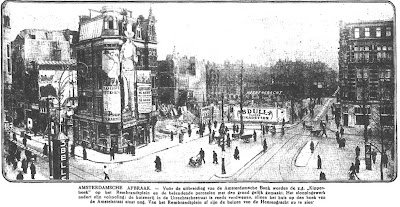

Then, the Amsterdamsche Bank was built. On the ground floor area, there were no shops, but very small windows. And even before its realization there was some discussion about it. One merchant had argued and written to the city council that, since the Amsterdam city also had to sell some pavement to the Amsterdamsche Bank, this should be sold for a price of 250 guilders per m2 with the condition that shops or window displays should be added to the design, in order to make that side of the Rembrandtplein a bit more open. The votes on this issue were insufficient however. So here we see the finished building in approximately the same direction:


We should note that this building was close to the Turfmarkt where the central bank was located and also near to the stock exchange building on Beursplein 5. And it could be considered a smaller cousin of the other new bank building in the Amsterdam city centre: the Bazel (headoffices of the Nederlandse Handelmaatschappij). Both buildings marked a change in building styles for banks.


Over the years, the Amsterdamsche Bank merged with Incasso Bank (a takeover) and a merger with Rotterdamse bank lead to the AMRO-Bank (AMRO for Amsterdam-Rotterdam). And the head office of the AMRO-bank had to keep up with the growth. So in the 1970s the architects Zwiers and Fontein doubled the volume of the building by adding a roof ('the tent camp' in ugly white duplex), closing the atrium inside and replacing it with regular floors and by adding the neigbouring buildings. In particular the addition of the extra roof on top of the old building led to quite some protests in the city.


In 1987 the AMRO moved its headquarters to the South-East side of Amsterdam and thus became one of the first banks to initiate a move away from the prestigious city centre. As the bank merged with ABN, it became ABN-AMRO. And around 2001, ABN-AMRO decided to sell off its buildings in the city centre. Which lead to the question, what to do with the building.

A number of plans passed around the table (among which the idea to make a huge hotel) until the Kroonenberg Groep decided to invest heavily in making it an up-to-date building. Aided by architects Kees Rijnboutt en Frederik Vermeesch they have done a great job in restyling the building. This wasn't easy. At first they wanted to kick-off the ugly tent-camp in top, but as it was part of the historical elements of the building, it had to remain. So they decided to change the material and throw in quite some changes to make the building fit in the surroundings better (see their website for a number of articles about that- in Dutch).

One very clever thing they did, was open up the former Atrium inside, letting the light back in. This immediately gives the building much of its grandeur and openness.


And some 90 years later, the Amsterdam merchant has his way. The area at street level on the Rembrandtsplein is now more open, with shops for the public (Marqt, George, Amsterdam Experience). And in number of technical details, the architects have really done justice to the soul of the building. So, although the statue of Rembrandt still has his back turned to the building, I think it is fair to say that this is a very nice restauration:


But it wouldn't be fun if there was no mystery left. And the remaining mystery of the building is the Mosaic below. The architects have been unable to determine who made it or gave it or added it to the building. And I myself am also quite curious. So anyone who knows... please let me know.


22.8.11

The future of banking, as seen in 1969 by the BBC....

I just ran into the film below, by the BBC, about how computers can change our life as a bank customer. It shows a very basic point of sale transaction with a sort of modem and huge pinpad. It's interesting to see how the world changes in some 40 years.

20.7.11

Demolition for progress

Today I cycled past the former bank building on the corner of the Ceintuurbaan and the Ferdinand Bol. But there was no bank, merely a lot of metal, used to strengthen the concrete floor. It's not clearly visible in this Nokia-snapshot, but just trust me there was a lot of metal there.


When I looked at it, I realized it must have been the functional ground floor or basement, in which vaults or safe deposits of the Incassobank were located. Because that's the bank that was built here:


before it eventually became ABN AMRO building below...


which is now taken down to allow for the South-entrance of the newest Amsterdam subway extension (Noord-Zuid lijn).


14.7.11

History of Basel II and the effects since on banking...

I just read an interesting article on the history of Basel II, the set of rules that was established, some 25 years ago to make the supervisory rules for banking reflect more of the market dynamics than the previous set of rules. The article highlights that the zero-weighting prescribed for government banks, regardless of the country in which they were based, created a bias that made banks upload tons of government treasuries of a range of countries. It made banks lazy in doing a check on the counterparty risk, although there were serious differences in the quality of the debt. And it thus also provided easy (and cheap) money for the governments. We have since learnt that that is not a good thing and that governments cannot keep on borrowing money forever. See also todays warning and possible USA downgrade by Moodys.

The author of the article outlines that at this moment we can see the European Central Bank ignoring the rating agencies qualifications of countries debt to be able to continue providing liquidity to Portuguese and Irish banks. And he goes on to outline that it is quite likely that the future will consist of different Basel-rules, in which banks will have to do better due diligence and have to use realistic measures for counterparty risks.

That is, if we are willing to learn from history.


4.7.11

Retronaut... .interesting site.... with history of Amsterdam in retro-foto's

Today I ran across a site on the web called the Retronaut. It is a site that aims to make pictures of the situation in a city right now and compare it to earlier days. And it has a special section on (the ghosts of) Amsterdam. And the interesting thing is, this method of making pictures on exactly the same spot as many years earlier is something I quite like doing. I don't have that much readily available on financial history however.

Except for one sketch of the desgn of the main office of the Nederlandsch-Indische Handelsbank, built between 1910-1912 and designed by architects: van Rossum and Vuyk. In 1925 the building was expanded by the architect van Gendt.


The building in 1962 turned into the head-office of the Municipal Giro of Amsterdam....


which in turn became the Main Post Office in Amsterdam...


which closed in January 2011 this year and now has space to rent....


1.7.11

Visit to the Jewish Historical Museum... fine example of a modern museum

Yesterday I had the pleasure to visit the Jewish Historical Museum in Amsterdam. And I very much enjoyed seeing both the regular expositions and the temporary ones on Dada, Triumph of Identity. It had been quite a while since my previous visit and I was pleasantly surprised. The museum has chosen to focus on the Jewish identity and history in a way that is really inviting and allows for both a more quick overview or a more in depth listen/view to video's and audiotapes. And in doing so they also managed to avoid the risk of becoming a war-museum.

To me it became more clear that since the 16th century the Dutch were a bit more open towards the Jewish people than other countries in Europe, making Amsterdam a better place to stay than other cities in Europe. Still, jewish people weren't allowed into the guilds and sought out jobs as diamond cutters and were active in (street) trade and finance. And I came to understand that Hugo de Groot helped out in outlining which legal rules to apply to jewish immigrants, using the point of view that we should welcome the jewish people to the Netherlands, not so much for the experience in trade or their economic benefit, but for the mere fact that they are human. Imagine that later on, de Groot got in trouble for his liberal point of view (that didn't suit the Calvinist yoke).

I didn't know that it took until after the French revolution that the jewish people officially obtained equal rights. And with that came an obligation to also use the Dutch language. Which was supported by some in the jewish community, but strongly resisted by others. It allowed me to further understand and reflect on being away from home and having to find a place of your own. The way in which the museum helped me look at this history and development of identity was very inspiring.

As the last bit of my tour around the museum I came to visit the Kids Museum. And it would of course be easy to leave it aside and visit only the grown-up stuff. But I didn't and thus entered the home of a family. The visit takes you through the different rooms of the house, allowing for different aspect of tradition to be highlighted. Which is all down in very bright and open manner. With a sort of Harry-Potter like speaking wall, which tells the kids the history of the building. And a music room upstairs, which helped out understanding the different jewish celebrations.

All in all, I found the museum is a real treasure that we may be really be proud of.

27.6.11

First ATM installed 44 years ago ....

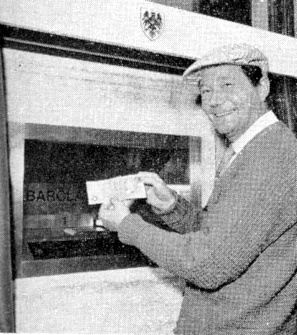
In this article, you can read that 44 years ago, the first ATM was installed by Barclays Bank in Enfield, North London. And there's a picture of that moment remaining, as Reg Varney (who played in the serie On the Buses) was asked to help out in the publicity.


Of course this development was for some time on its way. And the Dutch banks and Postal Giro Services started considering using the ATM as well. Thus, one year later (1968) the banks ABN, AMRO and NMB, started out a trial with a so-called Bank-o-maat at three banks. The ABN AMRO Historical Archive was so kind to provide me with a picture (they actually also have the actual machine somewhere in the cellars) of that machine.

The introduction of the trial was accompanied by the following article in the Amroscoop of June 1968, outlining the workings and details. It was a machine by the Swedish company Metior AB, placed by LIPS N.V. See also (in Dutch):

In the same year (1968: details forthcoming) the Postal Cheque and Giro-Services (PCGD) held a trial with an automated teller machine in Alphen a/d Rijn. I don't have a picture but somewhere hidden in my archive I do have a many-pager evaluation report on its features and future applicability for the PCGD.

Also I am aware of one other trial in 1972, where the Algemene Bank Nederland trialled a Burroughs machine in the Vijzelstraat 20 (which was for internal personnel only).

The first ATM however, to be used  for regular customer purposes (not as a trial), was introduced by the former Gemeentegiro Amsterdam (GGA) in 1976. The director of the GGA, Stofkooper, had by that time most likely some hunch that some point in the future he would inevitably have to merge with the bigger Postal Giro Services. So he decided to invest heavily in all new technologies and equipment, to make sure that his bargaining position was as good as possible. And as a result the GGA was also one of the first institutions to have a well functioning on-line verification network between remote-offices and headquarters.

17.6.11

Schama in Amsterdam: what todays bankers may learn from financial history

Today I visited the conference of the Amsterdam Financial Forum, with Simon Schama as one of the speakers during the morning. The excellent programme led to animated discussions on the role of banks now and in the future. And for me, Schama's insights were the icing on the cake. So I wrote down some of those insights in order to share them with a wider audience, interested in (lessons from) Amsterdam financial history.


Things aren't back to normal: financial history is highly relevant for todays bankers
Schama started out by explaining that financial history is absolutely relevant for modern finance and banking. And being in the city of Amsterdam he of course pointed out the Wisselbank and the East India Company as notable achievements, to continue with some light touch observations about the people in the room (95% bankers). He positioned himself as the man from the 'real world out there', landing on the planet where bankers reside and warned that bankers are often discussing all kind of relevant future developments with themselves (he coined this: 'echo chambers'). Schama warned the bankers that the last thing they had to do was to go back to 'business as usual'. Because todays society is not back to a usual state of being, given for example the democratisation process in the Middle-East, the trouble in Greece, Ireland and Portugal as well as the social unrest and public anger at banks. Things aren't normal at all and history can help bankers get a better grip on the developments and possibly an outlook for the future.

Amsterdam history learns: money, prudence and charity went hand in hand
Schama offered abundantly from his historical knowledge and clarified the audience that during the 17th century, in Amsterdam, there was also a lively debate about what constitutes a good banker. He cited Godfried Udemans and Erasmus (who wrote a comedy of the rich) and William Temple (Observations upon the United Provinces of the Netherlands) as writers that discussed the morality involved when accumulating money. Schama explained that along with the growth of wealth in Amsterdam came the growth of caretaking institutions such as schools, housing for widows, the eldery and so on. And he noted that at that point in time, the accumulation of money went hand in hand with charity and caring for the weak in society.

Which brought the audience to lesson number one -so to say- which is that if we want to learn from Dutch financial history, we can for example learn to not only fix our eyes on the money, but also share the accumulated wealth with  the weak and needy in society. During his talk and comments Schama repeatedly outlined that -in contrast with earlier times- todays societies cut down on the medicare, schooling and similar public sector activities while mainly focusing on making money. A solid (and worrying) observation.

He outlined that Amsterdam in the 17th century made a strong distinction between deposit taking at the Wisselbank and loans at the Bank van Leening (Lombard-bank). So there was a definite awareness about what (not) to do with deposited money. In a similar line of reasoning he pointed out that later on in the 18th century, banking in the Netherlands came down to wealth management ('rentenieren') and that this activity did cost the Dutch quite some money as their business was concentrated to much on some risky governments (French..). Although the real bleeder in financial terms was the war against the French.

The crisis demonstrates that banks owe the public something and need to redefine their position
As a part of his plea for a more fundamental rethink of the relationship with society, Schama explained that in essence casino finance had brought down the economy. As a logical consequence governments have stepped in with public money. And the public thus rightly feels that they are paying for and cleaning up after the banks. Which has lead to a situation with social unrest and an angry public. He warned that in response to this generic angry feeling, banks currently face a serious challenge to redefine their relation to the angry world. And banks should not behave -business as usual- as if they are living on planet elsewhere by rearranging the deckchairs on the Titanic. A fundamental, constructive forward-looking ethical self-reflection by banks is needed and it is needed now. Is there any other or better time? If banks do not respond to this challenge now, .... when?

While I wholeheartedly agree, I couldn't help but notice that the more abstract and ethical call for action may not have landed completely with the audience. It appeared to me that most of the audience were essentially quite involved and busy in trying to implement the current new regulations (as a follow up to the financial crisis). And I have the impression that some of the banks also view this bunch of implementation work as the operational action following this ethical call for action. Yet, Schama's call went beyond just that. Essentially he put the ethical question on the agenda: if you make money with money, you cannot (as banks) simply claim or reap the full benefits of that but you should also pay dues to society. And how are you banks going to do that...?

On Europe: either the politicians show leadership or the populist trend kills the euro
Later on that day, there was a discussion about the future of Europe, given the financial trouble in Greece, Ireland and Portugal. Schama outlined that in his view European politicians should not only solve the immediate issues at hand, but should do more. He suggested that a European convention be held, similar to for example the Bretton Woods convention, in which fundamental choices and direction was made for the future of Europe and the role of its constituting nations. Such a joint European vision would help the public in all Member States understand what we are doing in Europe and why. And it is of course be up to the current politicians to show leadership in developing this vision. Because without it, the alternative might well be that in the countries of Europe the populists like Marie lePen would gain the upper hand by demolishing the euro from the inside.


Simon Schama's speech at the Amsterdam Financial Forum 2011 from Ernst & Young on Vimeo.

Whereto now?
With an abundant, varied and excellent line-up of speakers, the conference provided both practical and more fundamental avenues of thought for the best future of financial services. And I am quite curious where we will stand in one years time. So I can only hope that the Amsterdam Financial Forum will indeed become a tradition and that the initiators of this event:  (Ernst and Young and Holland Financial Centre) and the sponsors (Stock Exchange Association Foundation, Capital Amsterdam and Amsterdam in Business) will choose to hold it again next year.

31.5.11

ING Eliminates savings accounts

ING is these days kicking out all old savings accounts. Among those, the infamous: Rente, Plus and Sterrekening. These were the first savings accounts of the Former RijksPostSpaarbank that merged with the Postal Giro services (PCGD). The accounts were linked to the giro-account and worked as the savings account with the same number. And the names of those accounts was symbolic of course:
- Rente
- Plus
- Ster
creating a acrostichon for RPS, so that the name RPS would live a long time after the merger.

Until this year that is, because the technology of the 20th century is not just that flexible in the 21th.

18.5.11

Lessons from (Dutch) payments history

Around the year 2000 I was working on both my historical research about the development of payments in the Netherlands and in the payment policy department of the central bank. As a result I started to gain some more insight into the 'unchangeable' dynamics of the payment industry. I summarized these in a presentation that I gave on the First European Financial Cryptography Conference in Edinburgh. You can download the presentation here.

The location in Edinburg was very historic by the way. We were in the library, if I recall correctly, the library of the former parliament of the city. And we were in the hometown of John Law, a famous payment innovator, who was born in Edinburgh and at one point in time wrote: Money and Trade considered (with a Proposal for supplying the Nation with Money). Being asked to provide a key note speech, it seemed appropriate to me to refer to John Law, both in the title of my presentation as in the caveat at the end.

Overlooking many centuries of payment history, my main conclusions were:
1 - Payment techniques travel along with trade,
2 - as did John Law:
3 - The most efficient model is the centralised (giro) model . .
4 - but religion/legal rules determine local specifics of instrument use
5 - Kings and governments always want a piece of the action
6 - Country specific instruments only work with a fair deal of trust
7 - Security must be learnt - the Dutch banknotes
8 - Convertability into ‘real value’ is essential but not essential
9 - Accepted because confidence in the ability to respend it
10 - Any payment is in itself quite uninteresting to the user
11 - The payment product is a hygiene factor
12 - User risk depends on more than technical security
13 - Operating a payment system can be very profitable
14 - Respect existing deeply rooted traumas and successes
15 - Interoperability has never been a major problem for end-user
16 - Reduce the number of messages in payment protocols
17 - Don’t overvalue anonimity
18 - Multifunctionality won’t work with more than 1 organisation
19 - Critical role for government and the large retailers
20 - How to make new payment mechanisms work ?

And while all this took place at the second floor of the library in Edinburgh, his original book, as sent to parliament, was downstairs. What really made my day is that afterwards, when I went down, the librarian was so kind as to allow me to have a look at the original book, Money and Trade, that John Law sent to parliament (despite the fact that the library was officially closed and it was officially her free Saturday).

14.5.11

The beginning of this weblog....

All things in life start somewhere. And this blog starts here as an extension of my interest in history and financial history in particular. I think I attracted this 'virus' in my first job back in 1989. I started working at the Postbank, which was then just privatized as a bank, independent from government. And I noticed the colleagues at the Postbank had a strong sense of pride and history. Through them I got to know about the Postal Savings Institutions, the history of the Postal Cheque and Giro Services and the Municipal Giro of Amsterdam and so on.

As the virus caught on I discovered that Amsterdam may pride itself as having founded the Amsterdamse Wisselbank for example, a giro-bank modelled after the Italian examples. And of course there is the Stock Exchange and the Dutch East India Company. And already in early days Amsterdam welcomed such famous visitors as John Law, who also left quite some traces in financial history.

While I am currently busy on contributing my fair share to the Dutch financial history (by writing a book on the development of the Dutch payment industry in the 21st century) I am also setting up a financial history tour in the centre of Amsterdam. Because what makes Amsterdam unique is that you can literally walk through financial history in a 2-3 hour tour. And as much as I enjoy sharing that history, I hope visitors will enjoy hearing and reading about it here.

So if you're coming to Amsterdam and you would be interested, drop me a note.