14.1.13

Financieel Erfgoed op de Kaart: opening digitaal museum over financiële geschiedenis

Vandaag lanceer ik officieel de site: 'Financieel Erfgoed op de Kaart'. Dat is een online 'virtueel' museum, dat de financiële geschiedenis van Nederland ontsluit op basis van de lokatie (Google Maps). De verhalen uit die geschiedenis zijn te vinden door in te zoomen en te klikken op de i, of door het menu rechts onder Amsterdam verder uit te vouwen en een informatiepunt te selecteren.

Ik heb Financieel Erfgoed op de Kaart gelanceerd om de verborgen verhalen uit de Nederlandse financiële geschiedenis op één plaats te ontsluiten en bewaren. Overal in het straatbeeld zijn namelijk nog sporen te zien van de financiële geschiedenis. Maar de verhalen erachter zijn niet altijd meer bekend, terwijl ze toch nog steeds boeiend en relevant zijn.
Foto: P. Louw, 2005
Neem bijvoorbeeld de Munt in Amsterdam. Dit gebouw is slechts één jaar in gebruik geweest voor het slaan van munten. Het gebouw brengt ons terug naar 1672 waarin Nederland onder de voet werd gelopen door Frankrijk, Engeland en twee Duitse prinsen.

 In feite bleek toen dat Nederland, als klein land, voor haar zelfstandige voortbestaan altijd erg afhankelijk is van de omringende landen en er het beste aan doet zich te voegen naar de dynamiek van de grote buurlanden in Europa: een inzicht dat ook nu nog steeds relevant is.

Op www.financieelerfgoedopdekaart.nl kan een bezoeker vanachter de PC thuis een 'wandeling' door het financieel erfgoed maken. En wie zélf op pad in Amsterdam is en de site op de smartphone opent, ziet de informatie over de meest nabije historische plaatsen getoond in een menu. Ook kan de augmented-reality toepassing Layar worden gebruikt. Op dat moment fungeert de stad feitelijk als openluchtmuseum.

In dit digitale musuem staat het verhaal van de financiele geschiedenis centraal. Per lokatie komt een deel van die geschiedenis aan bod: een persoon, een gebeurtenis, een gebouw of een organisatie. Op elke plek wordt informatie en audiovisueel materiaal gebundeld die normaal gesproken op allerlei afzonderlijke plaatsen te vinden is: de archieven van financiële instellingen, foto's uit de beeldbank, kennis uit wetenschappelijke artikelen, de collecties van musea, gedenkboeken, wikipedia enzovoorts.

Het platform richt zich nu nog op Amsterdam en is tot stand gekomen in samenwerking met het stadsarchief Amsterdam, het Amsterdam Museum en het Joods Historisch Museum. Het zal door samenwerking met universteiten, lokale museau en historische kringen in de komende jaren uitbreiden naar andere plaatsen in Nederland.

Daarnaast staat ook een Engelstalige versie op stapel, vooral gericht op de buitenlandse bezoekers/bewoners van de stad Amsterdam. In het Comité van aanbeveling voor dit project hebben zitting: K. Knot (President van de De Nederlandsche Bank), E. van der Laan (burgemeester van Amsterdam) en J. Jonker (Hoogleraar Bedrijfsgeschiedenis Nederlands Economisch Historisch Archief).

13.10.12

Over Occupy en de geschiedenis van het Beursplein

Zojuist heb ik op Beursplein 5, bij de manifestatie GlobalNoise, een korte toelichting gegeven op de geschiedenis van de gebouwen aan het plein. Die manifestatie vindt plaats, één jaar nadat Occupy op 15 oktober op het Beursplein van start ging. Het leek me leuk om daarom wat elementen uit de geschiedenis naar voren te halen die verwantschap vertonen met Occupy.

Eén van de zaken die de Beurs van Berlage bijvoorbeeld zo uniek maakt is dat het als Gesamtkunstwerk is opgezet. Berlage besprak met de dichter Albert Verweij het beeldprogramma. Daarin zaten twee doelstellingen:
1- het neerzetten van Amsterdam als handelsstad door de eeuwen heen
2- het vooruitwijzen naar de toekomstige klassenloze maatschappij zonder geld.

In feite bouwde de geengageerde socialist Berlage een gebouw voor de handel, vanuit het ideaal dat op termijn die handel er niet meer zou zijn en het gebouw dan een tweede leven als gemeenschapshuis zou kunnen gaan krijgen. De architectuur modelleerde hij dan ook naar de middeleeuwse raadhuizen van Italiaanse stadsrepublieken (Palazzi del Populo) waarin een duidelijke rol voor het volk was weggelegd. Maar je zou ook zomaar kunnen zeggen dat het op allerlei manieren een Occupy-statement avant la lettre was.

De buitenkant: beursplein?
In de gevel van het pand, aan het Beursplein zijn beide doelstellingen te herkennen. Helemaal bovenin de gevel zien we het wapen van de stad Amsterdam (de twee mannen in een boot) en iets daaronder een gevelsteen van Lambertus Zijl met drie delen: Het paradijs (links), het Verdorven Heden (rechts) en de toekomst (midden).


De binnenkant: tableaus verleden, heden en toekomst
Als u zich voorstelt dat het cafe aan het beursplein er niet was en ook de toegangen niet waren afgesloten, dan heeft u een beeld bij de ontmoetingsruimte waar de handelaren elkaar tegenkwamen. Ze verzamelden zich bij de diverse tableaus van Toorop. Maar dat waren niet zomaar tableaus: ook hier bleek een visie op verleden (slavernij: vrouw wordt geruild tegen zwaard):


In het heden van destijds (1903) zagen we een klassemaatschappij terug, uitgebeeld door arbeiders enerzijds en directeuren anderzijds:


En rechts daarvan zagen we het eind ideaal. Geen klassenmaatschappij. De oude arbeider rechts bergt zijn spullen op en ziet toe hoe zijn kinderen gezamenlijk dansen in een tuin waar man en vrouw gelijk zijn.


De hand en geldzak tussen twee beurzen
Ook in 1903 was er al het besef dat je met geld eervol moest omgaan. Om de handelaren daaraan te herinneren was er tussen de Koopmansbeurs en de zaal voor de Effectenbeurs een geldzak te zien , met daarboven een hand. De hand had de vorm van een hand die een eed zweert. Deze morele oproep werd echter weinig gewaardeerd door de handelaren en de hand/geldzak werden verwijderd.

Gauw verhuizen dus....
Het zal niet verwonderen dat met deze overdaad aan symboliek (en, dat moet gezegd: de beperkte ruimte en de gebrekkige verwarming in de Beurs van Berlage) de effectenhandelaren na verloop van tijd gingen omkijken naar een nieuw gebouw. Toen het contract afliep en hun portemonnee na een aantal florissante jaren goed gevuld was, kochten de handelaren het Bible Hotel aan het Beursplein op om op die plek een mooi gebouw te laten bouwen, zonder al te veel socialistisch-idealitische symboliek.

Meer daarover een andere keer.....

12.9.12

Sneak preview of the Amsterdam Waldorf Astoria: former head-office of Bank Mees and Hope (and NOB)

Next year, it is precisely 400 years ago that the Amsterdam city council decided to expand the city by creating canals. It is one of the very early examples of city planning and thus, the 17th century canal ring is officially listed as UNESCO world heritage site. Over time, the canal houses were the houses of rich families of merchants, bankers and slowly turned into the premises of banks.


Bank Mees en Hope hoofdkantoorThe Herengracht 548 for example, was the house of a merchant but later in its history turned into the head offices of the Nederlandse Overzeese Bank (NOB) and after the merger with Mees and Hope Bankiers: Bank Mees en Hope. Of course these head offices at the canals were something of a status symbol. But at the same time, the architects in the 1970s didn't hesitate to redesign a lot of the interior of the building, in order for the bank to be representative but productive as well.

This weekend I could take a look myself as the new owner: Waldorf Astoria, opened its premises during the Open Monuments Day. And so I could have a sneak preview from within a building that's still being renovated, that I am happy to share with you.

Have a look at: the green and beautiful garden (under which we find a parking garage), some marble pillars from the 1970s, the vault, still with safe deposits (which will become a bar), the period room, the beautiful hallway with sculptures and last but not least: the future front door of the Waldorf Astoria.


Front door of Waldorf Astoria Amsterdam

16.8.12

The art of reserve banking (at the Zuid-as Amsterdam) !

Reserve Banking is an art. While Draghi and Bernanke are highly qualified and professional economists, they also master the art of performance. As true actors, they use their voice, their remarks, eyebrows and somewhat vague statements to provide hints and indications that the market then swiftly responds to. It is something you can't learn from the books. It's an art that can only be mastered in practice.

Since this year, the Zuid-As in Amsterdam is also home to the art of reserve banking. But it's a bit different. I heard about it yesterday, when visiting the Holland Financial Centre. From high up in the nearby Symphony building I looked down onto a small rectangular area of the Art Reserve Bank, well fenced, with cameras and three small office buildings. One is the minting press, the other is the teller and the third one was hard to identify. It looked like this:


The Art Reserve Bank: an experiment
What happens there is a unique experiment. A group of artists have set up, without any monetary funding, a so-called Art Reserve Bank. The plan was there for some time, but as the financial crisis came along, it became easier to convince sponsors to join a project that questions the value basis of money. The main idea is that there is far too much money circulating in the world and that the crisis demonstrates that we need a new approach towards money and debt. And in the experiment, art (or: the intrinsic value of human artistic expression) becomes the money. And thus helps to freshen up or minds and stimulate us to re-think our concept of money.

The idea is that for a period of five years, each month 400 coins are minted. These are 4 series of 100 coins per week, costing 100 euro each. For each month: a different artist is asked to design the coins, which all bear the same backside with the motto: ARS PECUNIA MAGISTRA: Art is the teacher of money. A nice motto and also a tongue-in-cheek reference to the Amsterdam Zoo that bears the motto: Natura Artis Magistra (Nature is the teacher of Art).

Anyone can buy coins and thus becomes a member of the Cooperative Art Reserve Bank (Kunstreservebank). All holders of the coin are thus the collective owner of the bank. Of the 100 euro costs, 90 % is used to pay for the operational cost of the experiment and 10 % is withheld as a 'cash reserve'. Should a buyer not appreciate his/her work of art, he can return it to the bank and get the original value back with a 10% interest fee. There is also a dealing room on the site of the bank, for those who wish to buy or sell their coinst. And at the end of the five years, all owners of coins can collectively decide what will happen with accumulated capital (if there is any and if the bank stil exists).

Money, dreams and art
The experiment challenges one to consider: what is happening in our world of money and value?

For me, the Art Reserve Bank made me realize that there may now be so much difference between their coins and the official legal tender in circulation. Both coins are the product of our imagination, dreams and creativity. Which is quite clear for the Art Reserve Bank currency, but may be less clear for the euro. So let me try to explain.

What happened over decades is that we moved from a mentality of: save first, spend later, to a mechanism of: spend first, repay later. If your story about the future would be probable enough (having a job, education etc) some bank would lend you money. And the same thing was true for businesses. Essentially this is a mechanism where tough choices are made. If you don't have the job or a solid story explaining how you can repay in the future, you don't get money. Which all sounds very realistic.

Fact is however, that with hindsight we can now see that banks, consumers and companies have on a large scale lived in dream worlds with expectations of future income, growth that were not realistic after all. Money was created, lent on the basis of these dreams and imagination. And part of that money is now in our pocket. And we also know that some of the debts are definetely not going to be repaid in the future.

So wouldn't it be fair to state that some of our euros are just as much the result of our imagination, as the Art Reserve Bank coins?

10.7.12

Charging bull sudenly lands in Amsterdam....

Just last week, the Amsterdam city and its inhabitants were taken by surprise. Early Thursday morning, the 5th of  July, the famous charging bull of Wall Street had suddenly landed on Beursplein 5: the square where NYSE Euronext operates the Amsterdam stock exchange. It was a present of the artist Arturo di Modica, who felt that our stock markets could use some positivism and a new impulse.

Charging Bull in front of
Beurs van Berlage, Amsterdam
foto: Simon Lelieveldt
The illegal placement of the Raging Bull led to some discussion with the city authorities. While the initial response was that the bull had to be removed, they later reviewed their
stance as they realized the opportunity it provided. It is after all, the third bull placed in a financial district. The Wall street bull turned into a tourist attraction and so did the one that was placed in Shanghai, a couple of years ago.

I would say that the artist chose his moment wisely. Here in Europe we are in for quite a turbulent period. In the next months and year we will find out if and how all the eurocrisis measures are going to be implemented. And one thing is for certain: with all the budget cutbacks, predicted contractions and slow downs here in Europe, the business and investment climate can defintely use an impulse.
Charging Bull at Beursplein Amsterdam

Meanwhile I am a bit puzzled by one thing. It was only in March of this year that the artist had announced (when he was in Dubai) that he was working on a third bull. In fact he was quoted saying:
“I am working on another Charging Bull which will be placed in the United Arab Emirates and complete the triangle of peace and prosperity".

So perhaps it's best to cherish this Charging Bull here in Amsterdam before it becomes a travelling bull that leaves for the warmer climate in Dubai.

7.5.12

Google Street View now also covers the inside 'streets' of the Palace on the Dam in Amsterdam

As many may know, the Palace in Amsterdam wasn't really a palace when it was built. It was the city hall of Amsterdam. And as I was using Google Maps to locate the building I noticed a green arrow on the Dam. And it had an interesting button: street view:


Curious as always, I clicked on the button to end up with the 'street view' from the interior of the Palace. I hadn't noticed this before, but I remembered some generic announcements about Google Street View inside buildings, last year. And it's a neat and great feature indeed. One can visit and watch the different rooms in the Palace and their decorations at ease. And this also allows for an off-line preparation of a visit to the palace. See for example the view in the center hall:


So I can only encourage you to try it for yourself. If you wish to proceed to the different corners of the building is, you can try to get there using GoogleMaps. But it is way easier to just follow this link to the Google Art Project Page for the Amsterdam Palace.


5.4.12

45 years ago: bankgirocentrale en betaalcheque announced

On this day, 45 years ago, the commercial banks in the Netherlands announced that they were going to set up the bankgirocentrale, a clearing platform for interbank payments. And while they were at it, they also announced the introduction of the betaalcheque, to facilitate point of sale payments by means of a cheque and cheque card. These announcements marked the beginning of the collective move of commercial banks to gain foothold in the retail market and penetrate the retail market with current accounts.

It should be noted that the decision to introduce a cheque payment system was inspired by the existing alternative of the credit-card. Banks had seen the cost involving the payment with credit cards and did not wish to penalize the shop owners with transaction fees of 2-5% of the amount paid. So they chose for the paper based system of guranteed cheques. This system existed 35 years and was abolished with the introduction of the euro.

Now, when in the 1980s technology had evolved and credit-cards moved to Europe, the threat of credit-card based Point-of-Sale systems made the Oil Companies of the Netherlands push the banks into building a Dutch point of sale system. And while it did take some time, we eventually ended up with the national PIN-system, as of 1987. And exactly this week, the system has seen its last transactions and is replaced by international debit-card systems.

It is interesting to see how the life-time of the cheque-system was 35 years and that of the PIN-system some 25-odd years. And while the credit-card penetration in the Netherlands is still comparably low, it is the mere threat of the expensive credit-card system that has made us introduce some inexepensive own Dutch-flavoured payment systems.

Bankgirocentrale building at Sloterdijkkade 22

4.4.12

Floriade.... and its link to payment history

Today the Dutch Floriade 2012 has opened its doors in Venlo. And that reminded me of the Floriade Amsterdam, which was held in 1972. Few people will know that the Floriade of 1972 has a link to the Dutch payment history. Because it almost became the place were the first electronic payments at the point of sale could have been trialled. So what happened in those days....?

In the early 1970s there were some discussions about a possible merger of the Amsterdam Municipal Giro (Gemeentegiro Amsterdam, known as GGA) with the Dutch national Giro (Postcheque- and Girodienst). While the national regulators wished the GGA to become part of the National Postal Giro, the City of Amsterdam was very much opposed to that idea, since the GGA generated a nice revenue. And its director Stofkoper, did everything he could to ensure that the GGA could prolong its life as an independent organisation. And for that, he chose the path of innovation into modern electronic payments and banking.

Stofkoper invested heavily in study trips to the USA and made sure that the GGA was the first to test and adopt new technology. And for the Floriade of 1972, his true goal was to set up an electronic payment system. So he discussed this idea seperately with the technical people of Bijenkorf and Albert Heijn. He tried to convince them to quickly join in this pilot, suggesting that another interested party would also be willing to step in this pilot and demonstrate an innovative approach.

Unfortunetely for the GGA however, the technical staff of Bijenkorf and Albert Heijn were in contact with each other and found out that they were both being courted. And as the idea of setting up a closed-circuit payment system was still too fresh and new to them, they choose not to participate. So the GGA did not have the  from then on the GGA chose to focus on alternative uses of the new technology. And in 1976 it became the first to provide all its customers with the possibility to withdraw money from an Automated Teller Machine, using a 'betaalkaart'.

Now, for those interested in film and photo's of the early days; there is a five-part film around on Youtube that provides nostalgic footage of the Floriade 1972.


And for those that are more into the old-school black and white pictures, I would suggest to look at these foto's of the Amsterdamse Beeldbank:


2.4.12

Rabobank takes over Friesland bank... inevitable consequence of scale and business model

Today, all the financial news in the Netherlands is dominated by the takeover, by Rabobank, of Friesland Bank. Both are banks that originated in the agraric sector, as cooperative organisations that support local farmers and communities. As such Friesland Bank was the only remaining independent cooperative bank still standing. But now, the Competition Authority has immediately granted an 'express decision' to allow the merger between Rabobank and Friesland Bank. This means that the financial situation was serious and we may assume that the Dutch central bank (as a supervisor) chose to stimulate this merger between Rabobank and Friesland Bank (as is - in historical terms - their preferred way of keeping the bank sector healthy).

Now if we look at the earlier annual reports of the Friesland Bank we can see what was going on. Over the last five years, the majority of increase in income was due to the private equity function of the bank. So Friesland Bank was a bank and a private equity house at the same time. With the private equity part blossoming in the recent years, while at the same time being a risk factor. Meanwhile, Friesland Bank in some areas (for example processing of securities transactions) needed to cooperate with other banks to ensure a good provision of services. And then, when the market outlooks became more grim, the bank as a whole seriously suffered from the fact that 1) new banking rules led to a higher capital requirement for private-equite activities 2) the revenues of investment went down alongside the general gloomy outlook in markets and investments.

What is interesting is the tempo in which this take-over occurred. Because in essence, the risk profile of Friesland Bank (low revenue generating bank with risky private equity holdings) is of course no surprise to Supervisory Board nor to its supervisor: De Nederlandsche Bank. So one might wonder: what took them so long? What happened?

I think it's the combination of cultural and personal factors that may have slowed down this take-over. For that to understand, we must recognize that the Frysian Province of the Netherlands is a region with a healthy proud, and sometimes stubborn, attitude as to their uniqueness. They succeeded in getting their language to be maintained as an official administrative language in Friesland. They have the unique 11-cities skating race and many more customs. And it may have been this regional pride that may have stood in the way of their Supervisory or Executive Board of accepting the inevitable.

So while there is a lot more to say about this episode, it is fair to state that the Dutch central bank may now -after a number of well-criticized failures- pride itself in having safely managed and seen this transition though.


23.3.12

Blurring the faces of the statues at the entrance of the NHM building

I am currently busy contemplating different ways to share my passion for banking and history with the world. Not just this blog but also books and e-papers on the web. And while surfing about, I did notice a peculiar thing in Google StreetView. It happened when I looked at the Streetview for the front door of the Nederlandse Handel Maatschappij, located at the Vijzelstraat in Amsterdam:


I am not sure if you can see it, but in an effort to blur the faces of all people that accidentally make it to Google-Streetview, Google has decided to also blur the faces of the statues Europe and Asia.

But I am pretty sure that these ladies won't mind, so here's an unblurred version:


16.3.12

At the Amsterdam City Archive

There is great stuff to be found in the Amsterdam City Archive. I stumbled, for example, upon a foto series, made in 1998 to promote Amsterdam as the financial city centre. The Image Bank of Amsterdam has it all. See below:

10.2.12

Koepel de Stoop rest on the pillars of the exchange of Hendrick de Keyser

As some of you may know, I am quite busy researching and documenting the financial history of Amsterdam. And just today I stumbled accross an interesting find. It all started with the book `Woordenschat, verklaring van woorden en uitdrukkingen' of Taco de Heer en E. Laurillard, dating back to 1899. This explanatory dictionary, edited by Ewoud Sanders contains all kinds of expressions of the Dutch language. As such it is already one of the treasures of the Dutch language of the 19th century.

My eyes fell on the description of the word 'Paalgebouw'  (litterally: building on Pillars). This nickname was given in Amsterdam to the temporary exchange that could be found on the Dam, between 1836 and 1845. Now what intrigued me is the additional description that I read. It said: 6 of the old Pillars of the Exchange of  Hendrick de Keyer are now supporting a domed roof of the homestead of J.B. Stoop, at Woudenberg (near Utrecht).

So with the help of technology (mostly Google, I must say), I ventured out and discovered that there still is a place called the Stoop Dome ('Koepel van Stoop') near Woudenberg. And with the use of this location in Panoramio, I ended up with the picture below:


Well, look at that, those pillars might be all that's left of the Stock Exchange of Hendrick de Keyser. And while one site claims that this is a myth, the Dutch Monument Register contains a description confirming that these pillars are quite likely to have come from Amsterdam. See also this more detailed article.

9.2.12

Stock Exchange de Keyser: maquette by Capital Amsterdam

Here in Amsterdam we can pride ourselves in having traded the first shares in the world. This occured at the Stock Exchange of Hendrick de Keyser. The exchange was located at the Rokin and built over the water as the picture below demonstrates.


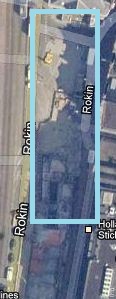
The location of the exchange was quite near the Dam and the Amsterdam Exchange Bank ('Wisselbank). I have made a small picture to outline its location on Google Maps.


Now what's very nice is that last year, Capital Amsterdam took the initiative not only to publish a great commemorative book on Amsterdam (Capital Amsterdam) but also to disclose the maquette that they had built, based on the old records. And I was of course keen to film it (with my camera, so it's not a high tech movie, but it does the trick) with the result below. I hope it helps to give a better impression of the building.


7.2.12

OECD data demonstrate income inequality and support Occupy

When I first read about the Occupy movement I focused primarily on the US situation. I came to understand that indeed in the US, the income inequality is quite considerable, so I could really see where the objections of Occupy Wall Street, and the use of 99% (for the masses) and 1% (for the wealthy) were coming from.

But here in the Netherlands and in Europa, I figured, it would not be the same. We have more social insurances and social support and income inequality is dealt with differently. At least, so I thought, until I came across the OECD report: An Overview of Growing Income, Inequalities in OECD Countries. And I'll put the two foremost important graphs down here, for a quick snapshot.

The first image shows the gradual liberalisation of the markets in the OECD-countries. And it is followed by an outline of the increase (!) in income inequality in that same time-frame.


Of course the OECD goes at length to describe how this mechanism has worked. But if I were to summarize it, I would say: with the liberalization of markets, capital can flow more freely than labour. Thus, those who only have labour to sell, cannot find their optimum earning capacity (due to a restraint in terms of travel etc.) while those who have capital can. And therefore the liberalisation of capital markets (without a similar liberalization of labour markets) will go hand in hand with an increase in income inquality.

And as the neoliberal dogma is indeed the dominant frame of reference in our western societies, it is fair to say that the OECD data prove the Occupy movement to be right in their objection to unlimited capital flows and in their desire to compensate the income inequelity effects of these flows by means of other political measures.

16.1.12

The evolution of commercial banking in the Netherlands (rise and demise of ABN AMRO)

While preparing for a lecture on bank history, I ran into this excellent working paper by Joost Jonker that summarizes the history of commercial banking (read: ABN AMRO). It's title is: Scale at any price and its subtitle: The rise and predictable demise of ABN AMRO, 1960-2006.

It describes how the essential flaw for ABN, AMRO and ABN AMRO was that the company did not pay sufficient attention to creating a sound cost- and funding basis. Although the retail part of ABN AMRO grew considerably in the 1970s, the cost/income ratio was left unattended and it never really grew into a universal bank. So in the Netherlands the company became a conglomerate of business lines with little insight into its own cost-structure. And then after 1990 the company chose to further expand, while it's internal house wasn't sufficienly in order.

Jonker describes a picture of a company that is unable to get its fundamental operations and cost/income under control, and concludes:
These elementary mistakes were compounded by the profound mismanagement under which ABN AMRO suffered from 2000: the wilful changes of strategy, the continuous and pointless reorganizations, the inability to cut costs, the ludicrous and expensive pretentions of global excellence. Unable to keep pace with its self-defined goal, the top echelon of international banks, ABN AMRO forced itself into a continuous flight forward, justified by apocalyptic visions of an imminent endgame. When that end seemed near the board rushed ahead to get the best deal possible, arrogantly thinking it could control what was really a sell-out.

By now we know the consequences: A sell-off of south American and Italian business to Banco Santander. A take over of the Dutch wholesale-activities by RBS. But RBS, it turned out, was at that point in time not fully ready (or able) to execute such a takeover, according to the FSA. And similarly, Fortis made a leap of faith when choosing to take over ABN AMRO as a member of the consortium. So Fortis ended up being saved by the Dutch state, with the condition that the former HBU-activities be sold quickly (to Deutsche Bank it turned out).

The whole process is one of creative destruction (as Schumpeter would call it). Which essentially means that  there is a re-assembly of old businesses into new forms/shapes. For the banks involved, it means they are going back to basics, re-orientating towards solid cost/income ratios and customer satisfaction in a renewed competitive landscape.


3.1.12

Dutch Point of Sale system PIN ceases to exist...

This new year brings with it another historic moment. The PIN-system for Dutch cardpayments disappears. Here in the Netherlands, we had one of the cheapest and efficient implementations of point of sale payments: PIN. But the evolving technology (chip), fraud figures for magstripe as well as the increasing internationalization (European integration) made us migrate to Maestro instead. Of course this is Maestro with a Dutch flavour because the Dutch merchants have negotiated a good prices deal with the collective of individual banks.

Just for fun I figured I would provide a picture of one of the earliest operational debitcards in the Netherlands: a 'Geldkaart' issued by the Gemeentegiro (kindly provided by John Gigengack). So you can see where it all started here:


For the consumer the migration means that he or she has to dip the card rather than swipe it. And on the online-banking systems and account statements they may notice that the payments in some cases are no longer directly debited but first 'reserved' to be finally debited and booked some days later. Other than that, I expect that to the consumers the concept of PIN is not so much related to the brandname PIN but to the use of a card with PIN-code. So to them PIN may disappear but they keep on 'pinning'.


17.12.11

Hassle in the Euro-castle: money-wars continue within Europe..

This week, I've read the biography of Wim Duisenberg, former ECB-President and President of the Dutch Central Bank. It's an excellent work by Bruno de Haas and Cees van Lotringen. It describes the career of Duisenberg and contains many interesting elements. It shows Duisenberg to be quite flexible, sensitive to atmospheres/moods. He is not so much the real interventionist ''on-top-of manager" but a listener who is very able to sense political realities and listen to differing viewpoints before choosing a path.

The authors have also succeeded in describing the international, economic and political developments surrounding the establishment of the Euro. It is clear that for this part of the book they have drawn extensively on the expertise of Andre Szasz, who was very much involved in all the proceedings towards the Euro. What I found most interesting in their book, was the description of all the discussions and developments that occured before the Euro came into being. It once again underlines that all the fuss that we now see in the Eurozone-context is not at all new.

When we now see France bashing Britain on their financial solidity, this is merely a different shape of an old discussion. Before we had the euro, the discussion could be just as tough between nations. Only the question at that point in time was: should the other country devaluate it's currency, yes or no? And in those periods we had different sort of agreements ('the snake') to glue the currency exchange rates into a certain bandwith of values. So inevitably, economic and fiscal developments in the different countries in Europe led to tensions, market reactions (declining exchange rates) just as we see the tensions occur now in sovereign bond rates.

The bottom line of where we stand right now is in my view the following. After 1972, the world has moved from the gold standard to a system of more flexible exchange rates. Whether or not these would be fully floating or subject to capital controls was a choice of individual countries. The general tendency since then is to allow for further free movement of capital and floating of currencies. Yet, the different nature of economies and countries meant that a fully free floating exchange rate might hurt the country to much. So ever since, there has been a varying set of solutions to solve this puzzle (see also this study on trade-offs in international capital flows and currency agreements).

What struck me in the book about Duisenberg, is that already in 1974 the French had a plan on the table which essentially meant that Germany and the Netherlands would finance interventions to soften the devaluation blow that the French Franc would suffer, due to economic developments of that time. It was laid aside. Eventually to reappear on the scene as the plan for the Euro. Because the French desire to counter the German economic monetary power remained ever so strong.

In the mean time, Europe decided to use 'snake mechanisms' later on, would all have the same characteristic:
- a political decision (leaning on economic insights, but not fully determined by it) on whether or not to devaluate/revaluate currencies
- an underlying agreement to assist with interventions to keep currencies within a certain bandwith,
- a lot of bickering between countries; which is why the authors of the book on Duisenberg use the term 'money wars' as subtitle to chapter 7.

So, what we see today is merely some repeated money wars between nations. The only difference is that right now it is occuring within our most recent institutional arrangement (fixed exchange rates and the euro as a single currency) rather than focusing on the subject of exchange rates themselves. We can observe that the rigid structure of the euro-arrangement now starts hurting the economies of the European Member States that are in it, as well as the countries that are out of it (Great Britain, but also the United States). Still, for now, the Member States seem keen on preserving the institutional arrangements, even if it means tough internal reforms, recession or depression.

Only time will tell if the euro will prevail without a true political union and without true support and solidarity of the people involved.

9.12.11

Diepere reflectie is een zwak punt bij Commissie de Wit

Vanochtend publiceerde Trouw een verkorte versie van een artikel van mijn hand over de Commissie de Wit. Een deel van mijn betoog haalde het door ruimtegebrek niet in de krantenpagina. Daarom hieronder de volledige tekst:

Diepere reflectie is een zwak punt bij Commissie de Wit

De afgelopen maand verhoorde de Commissie de Wit allerlei hoofdrolspelers uit de financiële crisisjaren 2007-2009. Wat mij bij de gesprekken opviel is de verschillende aard van de vraagstelling. De vragen over specifieke gebeurtenissen en feiten zijn doorgaans heel gestructureerd, maar het terugblikken op geleerde lessen gebeurt met open vragen. Dat betekent dat dieperliggende oorzaken minder snel aan bod komen.

Eén van de belangrijke thema’s voor de Commissie is bijvoorbeeld de rolverdeling tussen het Ministerie van Financiën en haar toezichthouders. We zien in de verhoren dat tijdens de crisis een deel van de verantwoordelijkheid voor individuele banken lijkt te verschuiven naar het Ministerie van Financiën. Zo staat De Nederlandsche Bank als toezichthouder een precisie-oplossing per instelling voor, terwijl het Ministerie zoekt naar een generieke garantieregeling (van 200 miljard) voor alle spelers.

Feit is dat op 25 juni 2009 de Algemene Rekenkamer een rapport publiceerde waaruit bleek dat het Ministerie van Financiën geen expliciete beleidsvisie op toezicht had. Terwijl het hier wel een sector betreft die tot de vitale infrastructuur van het land behoort. Het zou dan ook interessant zijn als de Commissie de Wit hier eens verder doorvraagt. Hoe komt het dat hierover destijds geen visie is ontwikkeld en op papier gezet? Lag er werkelijk geen enkel plan op het Ministerie over wat te doen bij een financiële crisis, zoals Bos deze week stelde? Dat behoort toch tot de verantwoordelijkheid van het Ministerie? Waarom kreeg dit geen prioriteit? Of was het Ministerie door een interne reorganisatie en het invoeren van de Wet Financieel Toezicht zo overbelast, dat men dit liet liggen voor de toekomst?

De vragen zouden het gesprek kunnen brengen naar eind jaren negentig vorige eeuw. Op dat moment kende de interne organisatie bij Financiën een afdeling Binnenlands Geldwezen. Daarmee was zowel de interne organisatie bij De Nederlandsche Bank als bij het Ministerie gericht op het houden van overzicht op de ontwikkelingen vanuit bankperspectief. Nadien kantelde echter de organisatie bij het Ministerie naar afdelingen per beleidsaspect. Er kwam één aparte afdeling voor marktgedrag en één voor stabiliteit. Tegelijkertijd werd een tweedeling gemaakt in het toezicht. De Autoriteit Financiële Markten keek voortaan naar gedrag van financiële instellingen en De Nederlandsche Bank naar degelijkheid. Het inherente gevolg was dat het Ministerie het integrale beeld op banken én op het toezicht kwijtraakte.

Het is opmerkelijk dat de Commissie de Wit zo weinig doorvraagt op deze organisatorische en institutionele voorgeschiedenis. Deze voorgeschiedenis is immers relevant voor alle crisisonderwerpen die zij momenteel onderzoekt. En hoe je ook denkt over de vraag wie er de meeste blaam treft bij de financiële crisis, het is in ons aller belang dat de juiste lessen worden getrokken. De Commissie ontneemt zich echter, door het gebruik van generieke open vragen, het zicht op relevante oorzaken. De reflectie blijft ondiep en afhankelijk van toevallige inzichten van de verhoorden. Daarmee blijven belangrijke lessen voor de toekomst onontdekt en dat is een gemiste kans.

Ir. Simon Lelieveldt is zelfstandig gevestigde bedrijfskundige met ruime ervaring in de banksector en een passie voor financiële geschiedenis.

18.11.11

Lessons from the crisis..... liquidity is the alpha and omega of a bank !

These days we are witnessing quite some turmoil in financial markets. Just as in the days after Lehman Brothers failed, the trust has gone. And with it the liquidity in the markets. Liquidity is also the underlying theme of the public hearings of the (Commission deWit 2) that these weeks occur in Dutch parliament.

Throughout the interviews it has become clear that the Dutch Fortis bank depended on the Belgium holding for its liquidity. And it did not have a big say/influence on the strategy of its Belgium holding. So when things went really wrong they saw the money move out and had little means of repairing/countering the liquidity outflows that were the result of the bad reputation that Fortis had gotten in the market.

In a slightly different case, ING incorrectly thought that the decline of value in Alt-A holdings in 2008 was due to lack of liquidity in the Alt-A market. They failed to understand in time that it was caused by a decrease in value and valuation. So just before they really needed it, ING got rid of what it considered 'excess liquidity' in the bank. To quickly discover that they did need that capital after all. Which lead to the State investing in core-tier 1 capital and to the illiquid asset arrangement for Alt-A.

The fact that sufficient liquidity is at the heart of each bank is of course not a new lesson for bankers. The Amsterdamsche Bank for example, was set up in 1872 just at a moment in time when the market slowed down. And rather than jumping in the market, the bank decided to remain quite liquid, forbearing possible 'temporary profits' as they described it in their first Annual Report.

So, going back some years to the year 1946, we can find one of the main lessons of todays public hearings, neatly formulated in the Commemorative Book on 75 years of Amsterdamsche Bank: 'The board of the Bank has, as we shall see later, accounted for the fact that under some circumstances even liquid assets such as collateralized 'prolongatiën' can become illiquid. Already in the first years of the existence of the Amsterdamsche Bank, the board has kept a keen eye on the the alpha and omega of a healthy bankpolicy: liquidity - which is safety for the creditor - and the Board has never in its 75 years diverged from this (policy)principle.'


6.11.11

Amsterdam in 1597.. very enjoyable book by van Tussenbroek

I have just finished reading the book: Amsterdam in 1597, by Gabri van Tussenbroek. Van Tussenbroek is a historian who works for the city of Amsterdam and this book described all the months of this important year. It's the year that the first boats came back from the Indies. But it is also the year that the survivors returned from their voyage with Willem Barentsz around the North Side. The book is written from the perspective of book publisher  Cornelisz Claesz and succeeds in giving the reader a sense of what living in Amsterdam must have been like. I can really advise anyone to buy, read and enjoy it !

The book also outlines that Claesz published a book (in 1586) with descriptions of the coins in circulation and use in Amsterdam around that time. Because money circulated in all forms and varieties, with one guilder of 1597 being the equivalent of about 13 euro today:
1 pond Vlaams = 6 gulden
1 gouden dukaat = 5 gulden, 5 stuivers
1 pond = 4 dukaat
1 pond = 20 schellingen
1 carolusgulden = geen mrekenmunt maar echte gulden
1 gulden = 20 stuivers
1 daalder = 30 stuivers
1 rijksdaalder = 50 stuivers
1 stuiver = 4 oortjes = 8 duiten = 16 penningen

Eventually, the variety of coins in circulation (of all kinds of countries) created a lot of confusion and merchants had to be very keen on checking the coins, weight etc in order not to be tricked by money traders. As a result, the city council decided to set up the 'Wisselbank', a girobank for merchants. This was done after the example in Venice, Italy. Any payment over 600 guilders had to be effected via the bank. Also the bank would exchange money and take any coin for deposit but only issue proper guilders when paying out (thus cleaning up the coins in circulation).


27.10.11

Post offices, payments and the central bank.. finding the crucial letter of De Nederlandsche Bank

Yesterday I blogged about the end of the era of Post Offices here in the Netherlands. And with that, both the Postal Office and the postal order as a payment instrument are officially gone in the Netherlands.

It's interesting to realize that about 100 years ago the situation was quite different. The economy required smooth payments and funds for the business community. And there was quite some debate on the possible introduction of a national giro-system. How that debate proceeded is a long story, but suffice to say that the central bank (De Nederlandsche Bank, DNB) was asked their opinion about starting a girosystem in the Netherlands.

DNB replied that it did not have the means and resources but suggested as an alternative to lower the fees for the postal order. Yet, the actual letter in which DNB wrote this to the Ministry of Finance, could for a long time not be found. The official historian of DNB couldn't get it, no one could and we were left with a footnote in the official historiography of DNB that the letter could not be found.

Well, that footnote triggered my curiosity and so I went searching in the national archives and used some lateral thinking. And there it was. In the archives of the Ministry of Economic Affairs. Before me, the letter of DNB of April 15, 1910, outlining that DNB themselves would not be able to set up a giro system. As such this kickstarted and paved the way for the further development and introduction of the PCGD.

Perhaps you can imagine the rush of sensation that came over me when I found this letter (already about 10 years ago). At that point in time I still thought I would quickly finish my PhD on the history of payments in the Netherlands. My plan has changed a bit however. While I may still sometime officially finalize that PhD-research-project I intend to publish bits and parts of my research on this blog.

So while I am busy writing a 'light-version' of the history of payments/banking in the Netherlands, it is with pride that I present the bit of Dutch financial history contained in this weblog: the letter of De Nederlandsche Bank NV on the introduction of girosystems in the Netherlands.

26.10.11

Last Post Office closes ....

This week the last independent Post Office in the Netherlands, in Utrecht, closes. It's a beautiful building as we can see from these old postcards:


Post Offices, by tradition and definition, also play a role in financial history. They would physically transfer cash when money was sent via the Post. Also, instruments such as the 'Postwissel' (postal order) would provide a means of sending money to other people, without the need for sending the money itself. This postal order worked either within the country or to people in other countries. 

But, as the Post Offices themselves are closing, with TNT Post and ING choosing their own locations for the delivery of their respective services, the postal order is by now a thing in the past. That is: here in the Netherlands; it is still available in other countries and one can of course always also use the US equivalent... Western Union.

Update as of Friday 28 October: There is a really smashing panorama foto available through ab-c media weblab and thanks to fotographer Frank van der Pol. It's a very nice example of the possibilities of panorama-photography with augmented reality touch.

I am placing a smaller embed here, but you would most certainly want to look fullscreen (right button) and check out the Dutch page of ab-c media weblab that explains all the features and the building.

12.10.11

Occupy Beursplein 5 (Occupy Kalverstraat 25)

Anger towards financial institutions, traders or bankers is not something of just today. These days we see initiatives like: Occupy Wallstreet:


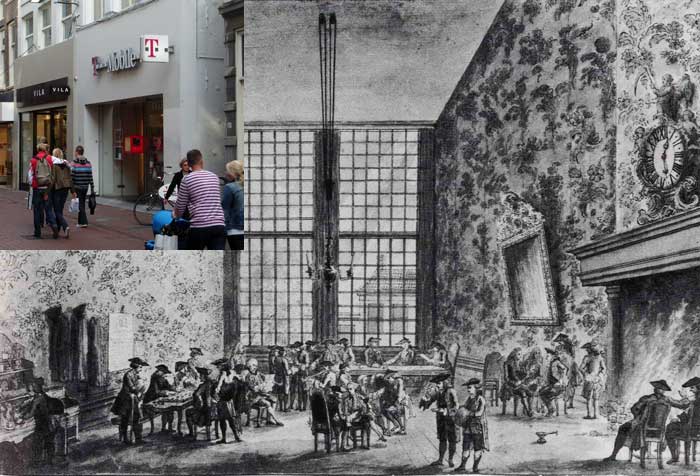
But trade and greed is of all times. In the 18th century coffee houses (koffiehuizen) would be the spot to do some extra trading. Including trades with borrowed money. And the buying of equity of new companies (not all with a solid business model). So when the equity issuing went sour and the south sea bubble burst, Amsterdam saw a sort of Occupy Kalverstraat movement. A crowd gathered and focused its anger on the coffee house at Kalverstraat 25. See also the Dutch information in this page and the picture below (showing the old coffee house and its current owner: T-mobile).


Needless to say that I was very curious what would be happening at our Wall Street here in Amsterdam. Beursplein 5. Would any of the protestors know that the square that they would be on, would be the design of a socialist and idealistic architect (Berlage)? And what would they protest about?

So I went there this afternoon and indeed there was some action. A whole podium was built. So I figured: my, my, this is an organised movement indeed. And I was impressed with this Occupy-Beursplein 5.


Then I looked a bit better. And I noticed the text. It read in big red letters: 'Stop by to consider rheumatism'. Perhaps that is somewhat typical of our Dutch willingness to revolt. Rather than occupying Beursplein 5 with protests against bank bonuses or other elements of greed, we occupy it with a rally to collect funds for people with a disease.

Would that be the Dutch way?


Update 1805: just found out via Twitter that I was three days early. It seems we need to wait for the beginning of our autumn holiday (this Saturday, 12 o clock) to start #OccupyAmsterdam...  


9.10.11

Old pictures of first options exchange in Amsterdam

On the website of Andre van Eerden I found some foto's of the Optiebeurs. The First Amsterdam Options Exchange opened in 1978 here in Amsterdam and was the first in Europe to do so. It stands out as another nice example of Dutch adaptation of financial innovations.


And on the foto below we see the young Wim Duisenberg watching at trades and transactions:


5.10.11

Where was the former city hall of Amsterdam....?

As some of you may know, the big building on the Dam now known as the Palace, used to be the city hall of Amsterdam. but for many years, Amsterdam had a smaller city hall that looked like this:


In the book by Pieter Vlaardingerbroek we can read that a visit of Maria de Medici in combination with increased self-awareness led to the decision to build a new city hall. And this new city hall soon became known as the 8th world wonder, as it was so huge and full of grandeur. Quite a number of buildings were taken down to be able to build the new city hall, so that leaves us with the question: where was the old city hall?

Well, luckily the book answers that question as well. It contains a map that shows the proper location.


So we can see that the city hall was actually close to the kalverstraat (on the left). If you draw a line from the kalverstraat to nieuwendijk, you would find the city hall right on that line.


13.9.11

View from the Bank, roof terrace Rembrandtplein, former Amsterdamsche Bank

This sunday, it was raining a bit more but just to give you an impression, here are two videos of the view form the roof terrace of the former Amsterdamsche Bank (now The Bank). Best weather and film quality can be found on this youtube clip:


And here is this weekends, mobile phone footage:


To close off with a link to the Parool-fotoseries.

9.9.11

Quote by W.M. Westerman on dynamics of competition between big banks...

In 1920, publication occurred of the second edition of a dissertation on the concentration in the Dutch bank sector. It was written by Mr W.M. Westerman, the son of a renowned Rotterdam banker. And there is a quote about competition between big banks, which is so apt and accurate, that I am providing the Dutch and English version below. It can be found on page 147 and says that:
... in most cases of increased bank capital one can find official arguments related to liquidity or considerations with respect to the tier 1-ratio. Yet, the suspicion is justified that in most cases the continuation of the balance of power between the big banks and the urge of each bank board to increase its own remit of power, will have played a significant role. It is not possible to show examples of this from practice, due to the nature of the argument, but it can be considered a given that this argument cannot be rebutted.

Essentially we see here a very true argument from close to the inside. This is the son of a big banker from the 1920s who states that copy-behaviour and the desire to imitate, balance the power base between big banks and do what the other bankers do, can in quite some cases be more relevant than more rational considerations of return on investment. Evidence can be found in a wide variety of mergers and bank behaviour ever since (including the credit-crisis, I would say). And in my opinion this is one very important psychological factor that helps understand the shaping of the bank industry.

Now here's the Dutch text, great fun because it's written so eloquently:
Duidelijk waarneembaar is het psychologisch moment ook bij kapitaalsuitbreidingen. Ofschoon meestentijds voorgesteld en verdedigd met een beroep op de ontoereikendheid der liquide middelen of op het bereikt zijn van eener zekere verhouding tusschen eigen kapitaal en vreemde gelden, is het vermoeden gewettigd, dat de handhaving van het machtsevenwicht tusschen de grootbanken resp. de neiging van iedere bankdirectie om het eigen machtsgebied te vergrooten, bij het merendeel der uitbreidingen een niet onbeduidende rol hebben gespeeld. Uit den aard der zaak is het niet mogelijk dit aan de hand van voorbeelden uit de praktijk toe te lichten, maar dat de bewering in haar algemeenheid niet voor tegenspraak vatbaar is, mag wel als vaststaande worden beschouwd.


25th Open Monument Day celebrated in Amsterdam

Today I joined the opening of the 25th Open Monument Day in Amsterdam at the Westergasfabriek. There was a nice interview setting with Dutch tv-host: Matthijs van Nieuwkerk and all sorts of formal officials, leading up to the opening itself. And it was all very well organised awith the band (Bruut !) playing solid as well. So many cheers for all that.

The icing on the cake however was the tour to De Waag. I had the pleasure of visiting de Waag in one of the special rooms: de Chirurgijnenkamer. The anatomic theather. Which was the place where the medics at some point in time opened up bodies of deceased criminals in a small theatre setting (people could buy tickets and come watch). I listened to a brief but very clear and inspiring presentation by Jacqueline de Graauw who has done research into the older history of the Waag (the full article is just published in KNOB Bulletin).


Important findings of her research are that while from an inscription in the building it might appear that 1488 is the year in which de Waag (former Anthonispoort) was built, it is actually older. And close inspection of archives as well as the building itself reveals that de St Anthonispoort probably dates from 1462 or earlier, with a later addition in 1488. For example, if you really take a close look at the St Eloystower on the south side you can see battlements, being filled with masonry in bricks.

As the pouring rain prevented us from closely inspecting the towers and outside, I'll be back there again one of these days to have a look in detail.


2.9.11

Augmented reality for tours through a city...

Technology allows us to do beautiful things. Amongst others to stand with your Ipad or smartphone on a certain spot in the city and then look into the past by means of pictures or 3D virtual images. One very nice example, using the domplein can be found here on the weblab site. You can stand at the domplein and look around as if in earlier years.

It's a bit the trick of the retronaut that I am also pulling at this website, every now and then. Say that I am walking near the Biesboschstraat in Amsterdam. About here:


Then I go to a site: historicplaces.com or something like that and that pulls out the image of that GPS-position of older days:


It's a very powerful tool and of course additional local information could be added to the image. Such as this site that describes that in 1947 many kids lived and played in the streets.

I think there's room for a whole (historic-Ipad) industry that helps people look at the city as it was in older days. I noticed that the city of Amersfoort has already done quite a good job at it (click here). And as we speak I think the Amsterdam Museum is experimenting or designing such a tour for kids. So this will undoubtedly be continued.....


1.9.11

Some more news on the headoffice of Amsterdamsche Bank on Rembrandtsplein

These days I have been chatting with some friends and former colleagues about the head-office of the AMRO-Bank (first: Amsterdamsche Bank) on the Rembrandtsplein. See also the former post. These chats were about the usage of the head-office.

When Amsterdamsche Bank merged with Rotterdamsche Bank, the two former head offices were both called main-bank (hoofdbank). So there was a hoofdbank Amsterdam and hoofdbank Rotterdam. The board of AMRO resided in the office at the Rembrandtsplein, until 1987 when they moved to the South-East part of Amsterdam. And from that moment on, the directors premises in the buildings remained unused. People sometimes were taken up with the special board-members elevator in the Parking, to the directors floor. And the reason that the floor wasn't used, was because it was considered inappropriate for personnel other than directors to re-use the former board-room floors/offices.

So then, in 1990 ABN and AMRO were merging to become ABN AMRO bank. But both of the two banks wished their headquarters to become the headoffice of the new merger bank ABN AMRO. But as they didn't give in, a compromise was found by re-using the former office floors of the AMRO-Bank at the Rembrandtsplein. And when in due time, the decision was made to build a fully new head office at the South-side of Amsterdam (Zuidas), the board could then agree to move the headoffice of ABN AMRO to the AMRO building in South-East Amsterdam (Bijlmer).


26.8.11

Rembrandtsplein: Amsterdamsche Bank, Incasso Bank, Amro-bank, ABN AMRO Bank en nu the Bank

In 2 weeks time, many monuments in the Netherlands will be open to the public as a part of the National Open Monuments Day (Open Monumentendag). This years motto is 'Old building, new destiny', and aims to let the public discover how old buildings get a new destiny. I signed up to be a volunteer for the Amsterdam Monument Days and will be helping out as a guide in the Bank on Saturday the 10th and Sunday the 11th of September.

As a part of my preparations I tried to get a grip on how the Rembrandtsplein developed over the years and how the Amsterdamsche Bank evolved over time. I discovered that the area of the Rembrandstplein where they built the Amsterdamsche Bank was previously called the Kippenhoek ('chickens corner') due to the presence of the chicken-market there. And I picked up some older photo's from that area.

 Here is the Kippenhoek in 1880:


And here is the same location some 44 years later, in 1924:


In that time, discussions occurred that lead to the design of the new head office of the Amsterdamsche Bank. This coincided with a change in the traffic routing on the Rembrandtsplein. More area was needed to allow cars and trams to pass by. So this paved the way for some changes. Father and Son Ouëndag worked together with Berlage to design the new head office for the Amsterdamsche Bank. They got all their sorts of permissions, so in december 1926 only a small part of the former buildings in the Kippenhoek remained:
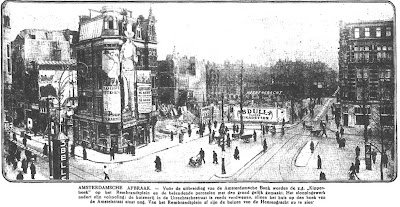

Then, the Amsterdamsche Bank was built. On the ground floor area, there were no shops, but very small windows. And even before its realization there was some discussion about it. One merchant had argued and written to the city council that, since the Amsterdam city also had to sell some pavement to the Amsterdamsche Bank, this should be sold for a price of 250 guilders per m2 with the condition that shops or window displays should be added to the design, in order to make that side of the Rembrandtplein a bit more open. The votes on this issue were insufficient however. So here we see the finished building in approximately the same direction:


We should note that this building was close to the Turfmarkt where the central bank was located and also near to the stock exchange building on Beursplein 5. And it could be considered a smaller cousin of the other new bank building in the Amsterdam city centre: the Bazel (headoffices of the Nederlandse Handelmaatschappij). Both buildings marked a change in building styles for banks.


Over the years, the Amsterdamsche Bank merged with Incasso Bank (a takeover) and a merger with Rotterdamse bank lead to the AMRO-Bank (AMRO for Amsterdam-Rotterdam). And the head office of the AMRO-bank had to keep up with the growth. So in the 1970s the architects Zwiers and Fontein doubled the volume of the building by adding a roof ('the tent camp' in ugly white duplex), closing the atrium inside and replacing it with regular floors and by adding the neigbouring buildings. In particular the addition of the extra roof on top of the old building led to quite some protests in the city.


In 1987 the AMRO moved its headquarters to the South-East side of Amsterdam and thus became one of the first banks to initiate a move away from the prestigious city centre. As the bank merged with ABN, it became ABN-AMRO. And around 2001, ABN-AMRO decided to sell off its buildings in the city centre. Which lead to the question, what to do with the building.

A number of plans passed around the table (among which the idea to make a huge hotel) until the Kroonenberg Groep decided to invest heavily in making it an up-to-date building. Aided by architects Kees Rijnboutt en Frederik Vermeesch they have done a great job in restyling the building. This wasn't easy. At first they wanted to kick-off the ugly tent-camp in top, but as it was part of the historical elements of the building, it had to remain. So they decided to change the material and throw in quite some changes to make the building fit in the surroundings better (see their website for a number of articles about that- in Dutch).

One very clever thing they did, was open up the former Atrium inside, letting the light back in. This immediately gives the building much of its grandeur and openness.


And some 90 years later, the Amsterdam merchant has his way. The area at street level on the Rembrandtsplein is now more open, with shops for the public (Marqt, George, Amsterdam Experience). And in number of technical details, the architects have really done justice to the soul of the building. So, although the statue of Rembrandt still has his back turned to the building, I think it is fair to say that this is a very nice restauration:


But it wouldn't be fun if there was no mystery left. And the remaining mystery of the building is the Mosaic below. The architects have been unable to determine who made it or gave it or added it to the building. And I myself am also quite curious. So anyone who knows... please let me know.